Opening
"This is a story, but the characters are real, and the incidents not imaginary." So begins the preface, and the author means it. He imagines his old comrades reading the book around campfires from the Arctic to the tropics, grumbling that he left out the best parts: the time Mac ran off with a tribe's tapu priest, the time Doc bluffed a whole tribe of cannibals single-handed. As for literary critics, he announces flatly that "for others, as you know, he does not care." This is not a novelist imitating an adventurer. It is an adventurer, briefly, imitating a novelist.
The Object
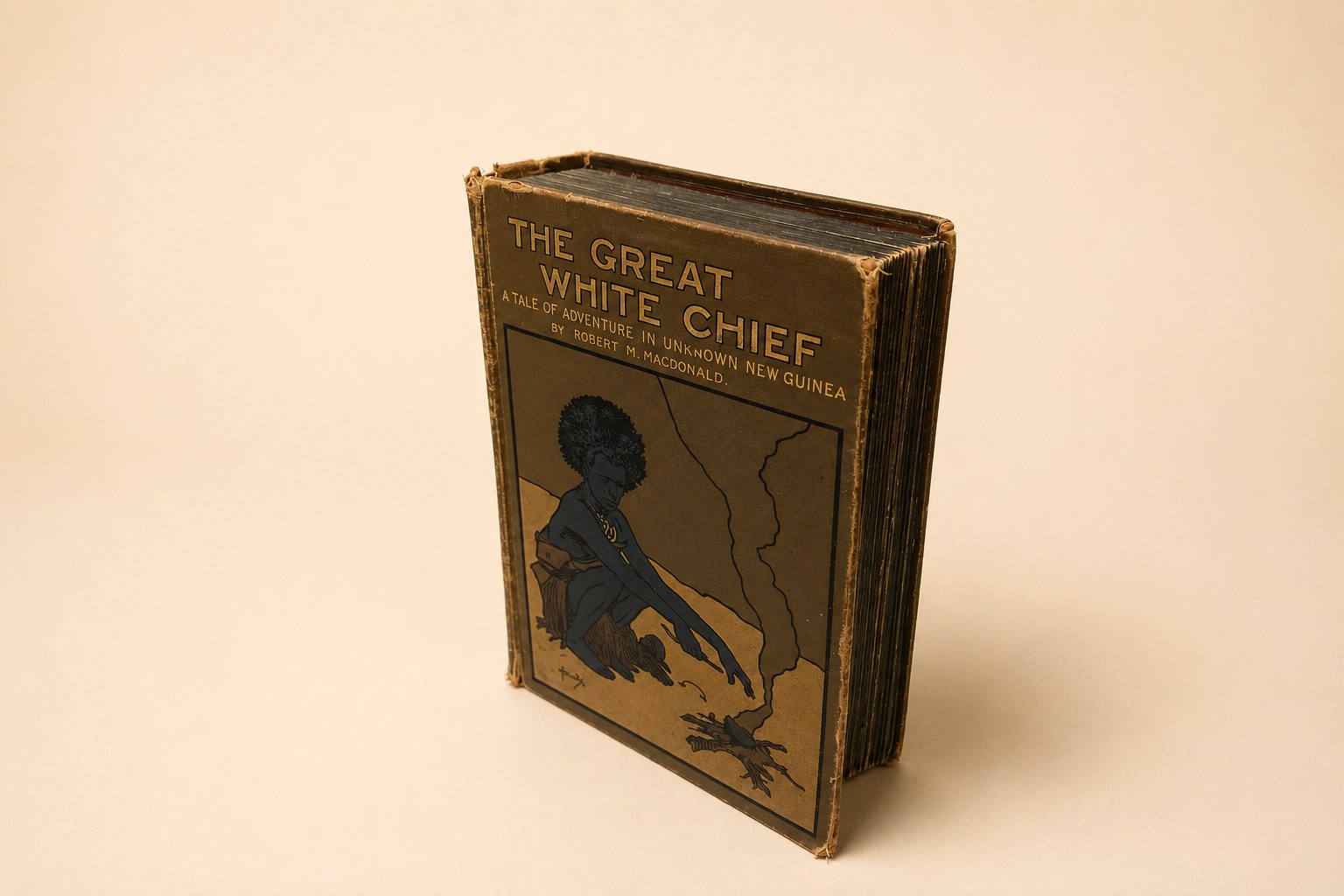
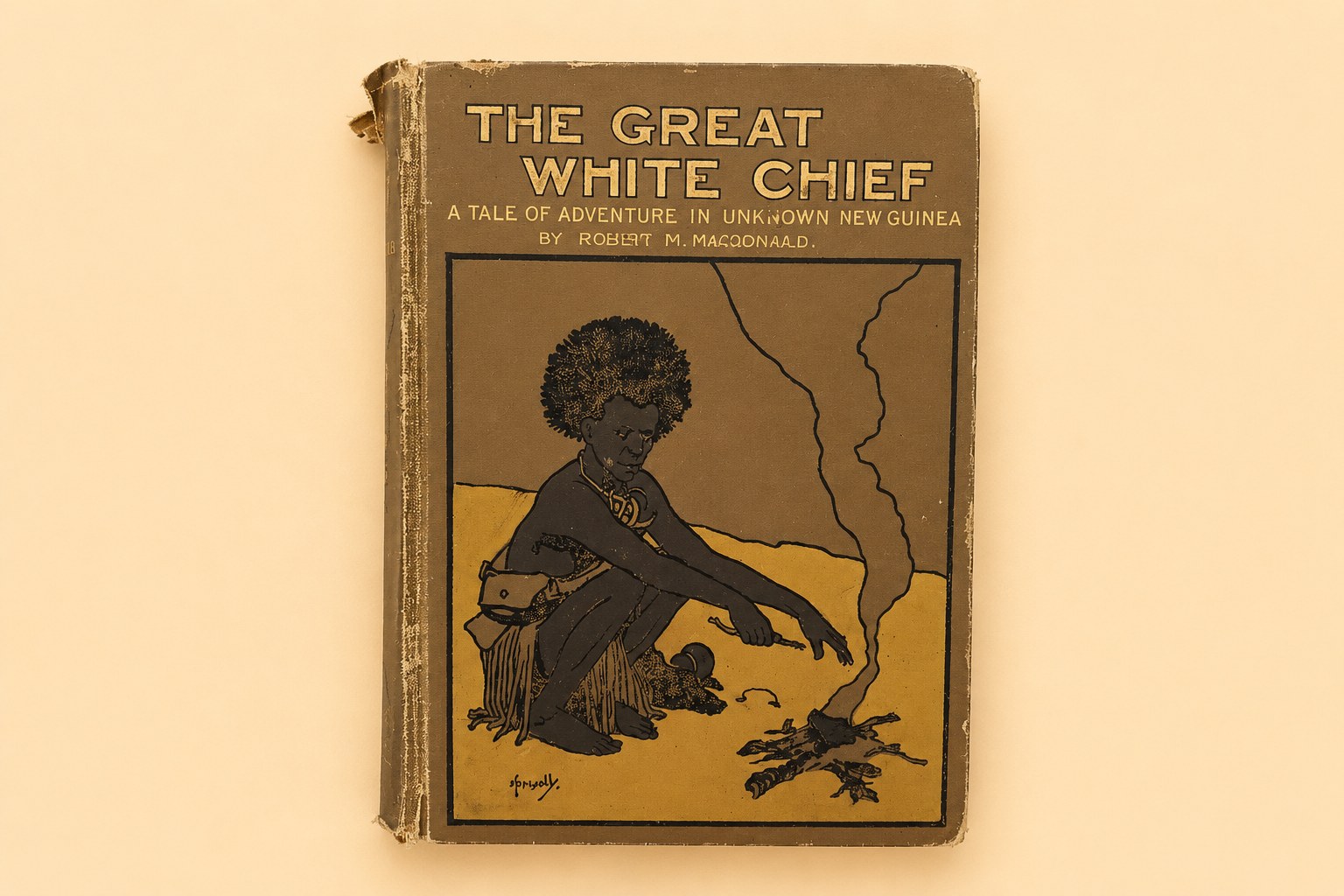
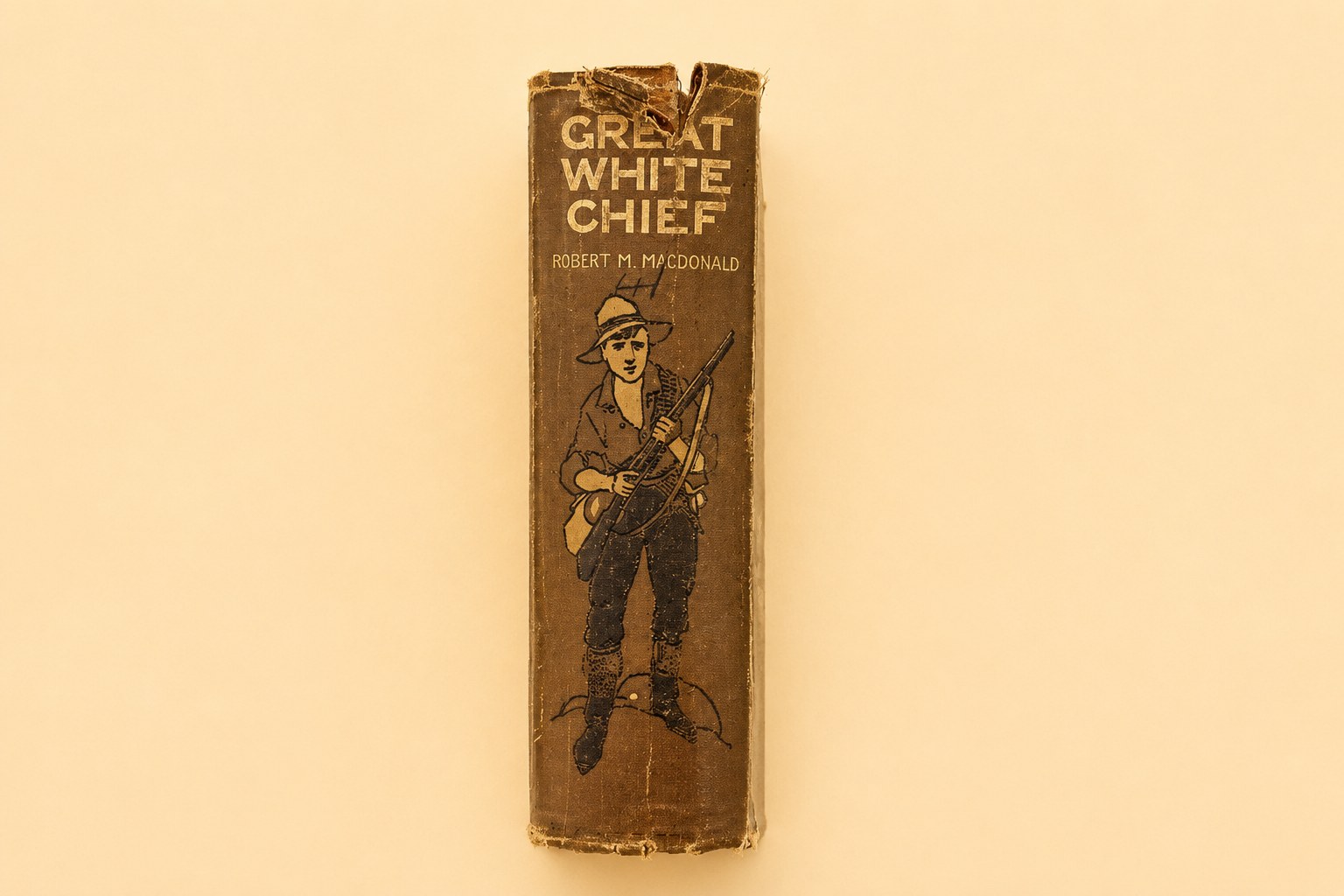
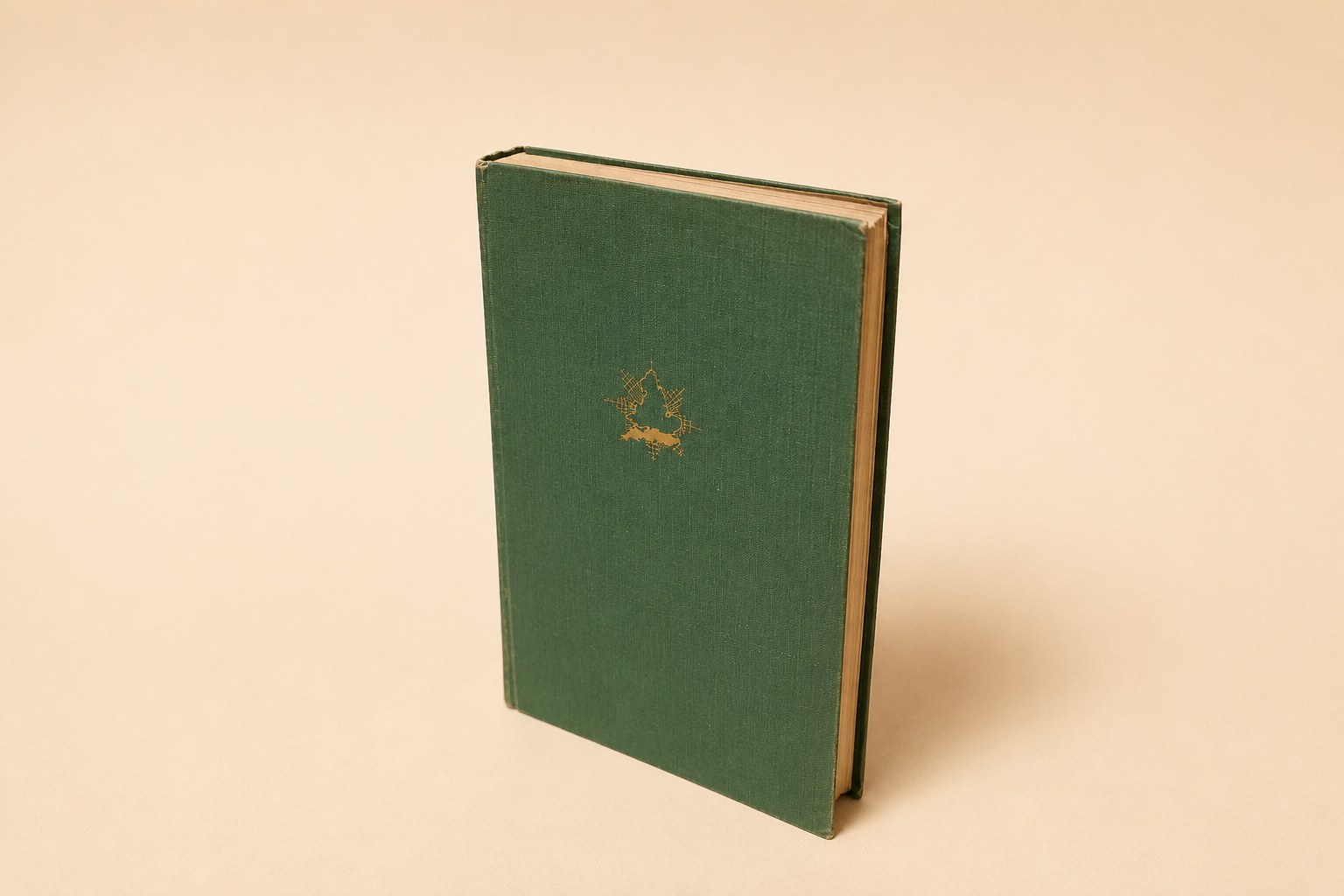
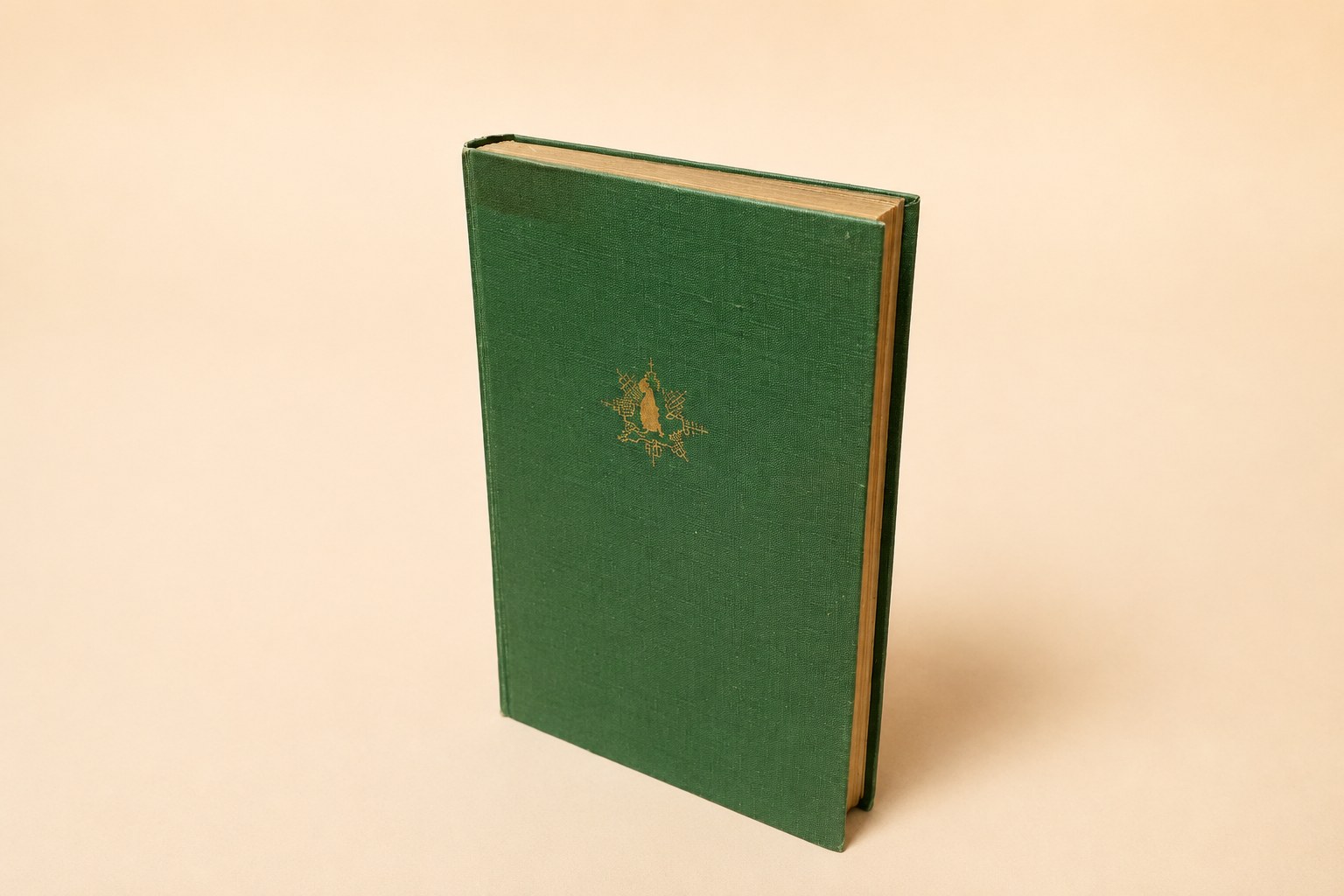
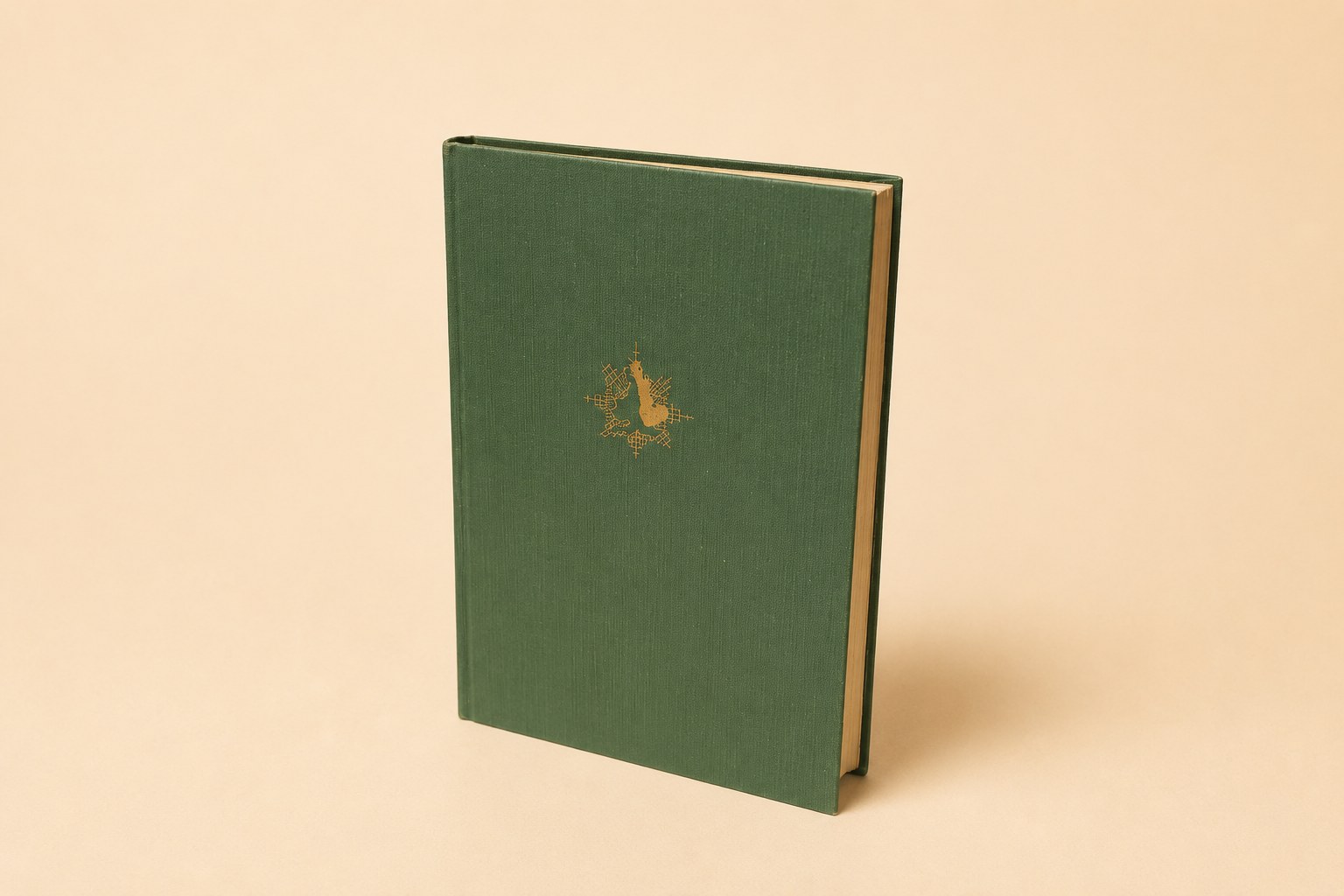
The Great White Chief: A Story of Adventure in Unknown New Guinea by Robert M. MacDonald was published in 1908 by Blackie and Son (London, Glasgow, Dublin, and Bombay on the imprint, with simultaneous US copyright) at the height of the Edwardian boys'-adventure boom. The binding is classic Blackie theatre: khaki-brown cloth with a full-colour pictorial front board (a crouching Papuan figure by a fire, signed by the cover artist in the corner), gilt titling, a second pictorial design on the spine of a rifle-carrying European in a bush hat, and green-stained page edges. Inside are eight full-page plates by William Rainey, R.I. (with titles like "His Hands rudely fastened around the Mamoose's Throat") and, more unusually, a folding map of part of British New Guinea: this adventure comes with real geography attached.
The story runs from an accident at Tilbury Docks to the interior of British New Guinea, through encounters with the Tugeri, a real southern-coast people notorious among colonial administrators for long-range headhunting raids, and across the border into Kaiser Wilhelm's Land, German New Guinea.
The Maker
Robert M. MacDonald is a genuine mystery. No standard reference work records his biography; what we know is what the book itself discloses. The dedication reads: TO ADMIRAL MORESBY, BY ONE WHO HAS FOLLOWED IN HIS FOOTSTEPS, John Moresby being the naval officer who charted the New Guinea coast in the 1870s and named Port Moresby for his father. The preface name-drops Mount Scratchley in the high Owen Stanley Range and adventures "in German territory." The most plausible reading (an inference from internal evidence, since no documentation of the author survives) is that MacDonald was a prospector or colonial hand who had actually been in the New Guinea interior and wrote up his experiences with the names changed. The illustrator, by contrast, was thoroughly established: Rainey had medals from Chicago 1893 and Paris 1900, illustrated Henty and Dickens, and has work in the V&A and National Maritime Museum.
The World It Came From
In 1908 New Guinea was one of the last genuinely unmapped places on Earth, split three ways between the Netherlands, Britain (the Territory of Papua, under Australian administration since 1906), and Germany. The interior was blank map. Into that blank, publishers like Blackie poured the era's defining youth genre, the imperial adventure yarn sixty-plus Henty titles deep, and a generation of British boys absorbed their picture of the world from gilt-stamped covers exactly like this one. The book is therefore double-edged today: a vivid primary document of how Edwardian Britain imagined its empire, with all the colonial attitudes that implies, and an apparently first-hand record of territory very few Europeans had then seen.
This Copy
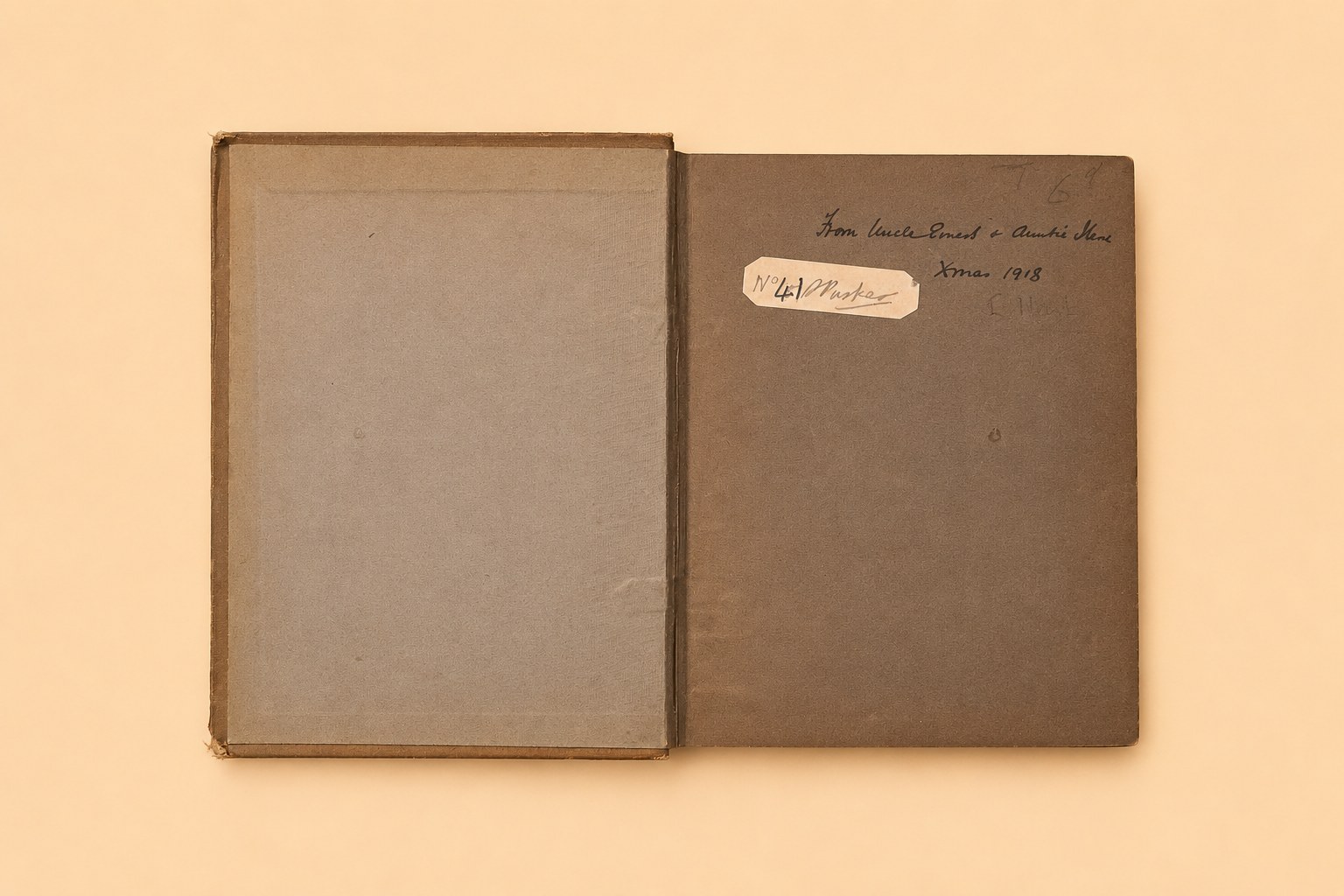
The front endpaper carries a gift inscription in neat Edwardian cursive: From Uncle Ernest & Auntie Here — Xmas 1918, with a small paper label (Nº 41, surname partially legible) pasted below. Christmas 1918: the first peacetime Christmas in five years, six weeks after the Armistice. Some uncle chose, for some boy, a ten-year-old adventure book about the freedom of the world's wild places; it is hard not to read the timing as meaningful, though that reading is ours, not documented. Condition is good for a well-loved boys' book: spine head worn, cloth splitting at the top joint, the colour cover still strong.
Why It Matters
Most Edwardian adventure fiction was written by men at desks in London. This one carries a credible claim (made bluntly, in print, by its author) to be the disguised memoir of a real New Guinea hand, dedicated to the admiral whose charts made the territory legible. That makes it more than genre nostalgia: it is a minor primary source for the European experience of late-colonial New Guinea, wrapped in one of the handsomest pictorial bindings Blackie produced. Add the 1918 Christmas inscription and the object spans two empires' high noon and the morning after the war that began their end.
References
- The Great White Chief (1908), National Library of Australia — digitised copy
- The Great White Chief, NLA catalogue record
- First edition listings, Biblio
- William Rainey, Wikipedia
- John Moresby, Wikipedia
- John Moresby, Australian Dictionary of Biography
- Port Moresby, Wikipedia
- Blackie and Son, Wikipedia
- Territory of Papua, Wikipedia
- German New Guinea, Wikipedia
- Marind-anim (Tugeri), Wikipedia
- Mount Scratchley, Wikipedia