Not one object in this collection is a weapon. There is no medal, no helmet, no shell casing, nothing forged for killing. And yet three of these gentle things — a boy's adventure story, an office typewriter, a classic novel — carry the two World Wars on their surfaces as plainly as a scar. War rarely enters a collection like this as hardware. It enters as context: the circumstances under which ordinary objects were made, sold, given, and read, recorded in an inscription, a serial number, and a date of printing.
The earliest trace is a single line of ink. The Great White Chief is pure 1908 in every fibre — empire, exploration, Admiral Moresby, unexplored New Guinea, the serene confidence of the late imperial world. But the inscription in its endpaper is dated Christmas 1918, six weeks after the Armistice, and it belongs to an entirely different planet: one that had spent four years counting its dead. To give a boy a prewar adventure story in that first strange December of the peace is to make the war visible by everything it had just interrupted — the lost world handed to a child as though it might still be inherited.
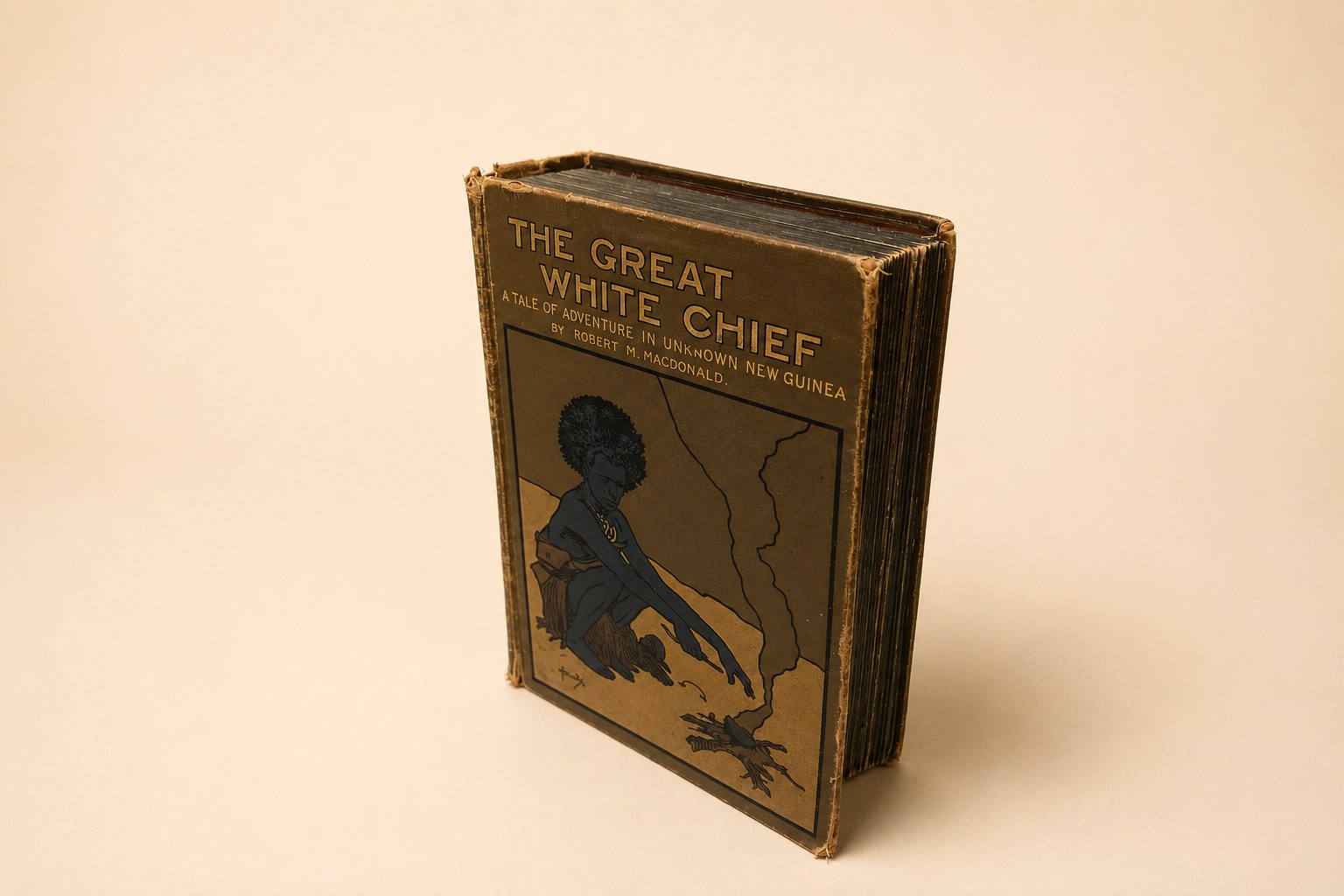
'The characters are real, and the incidents not imaginary': an Edwardian New Guinea adventure that reads like a prospector's disguised memoir, with eight Rainey plates, a folding map, and a Christmas 1918 inscription.
View object →The Hermes Media portable typewriter carries the next war in its workings. Built by Paillard S.A. in Switzerland around 1939–45 — precision manufacture humming along inside a neutral country entirely ringed by the fighting — it was then retailed through Taylor's Typewriter Co. at 74 Chancery Lane, in the legal heart of a London under bombardment. Picture the route: a Swiss machine crossing a Europe at war to be sold, lawfully and unremarkably, in the offices of a blitzed capital. The grand catastrophe reduced to logistics, and the logistics preserved in a dealer's badge and a serial number, 2018220.
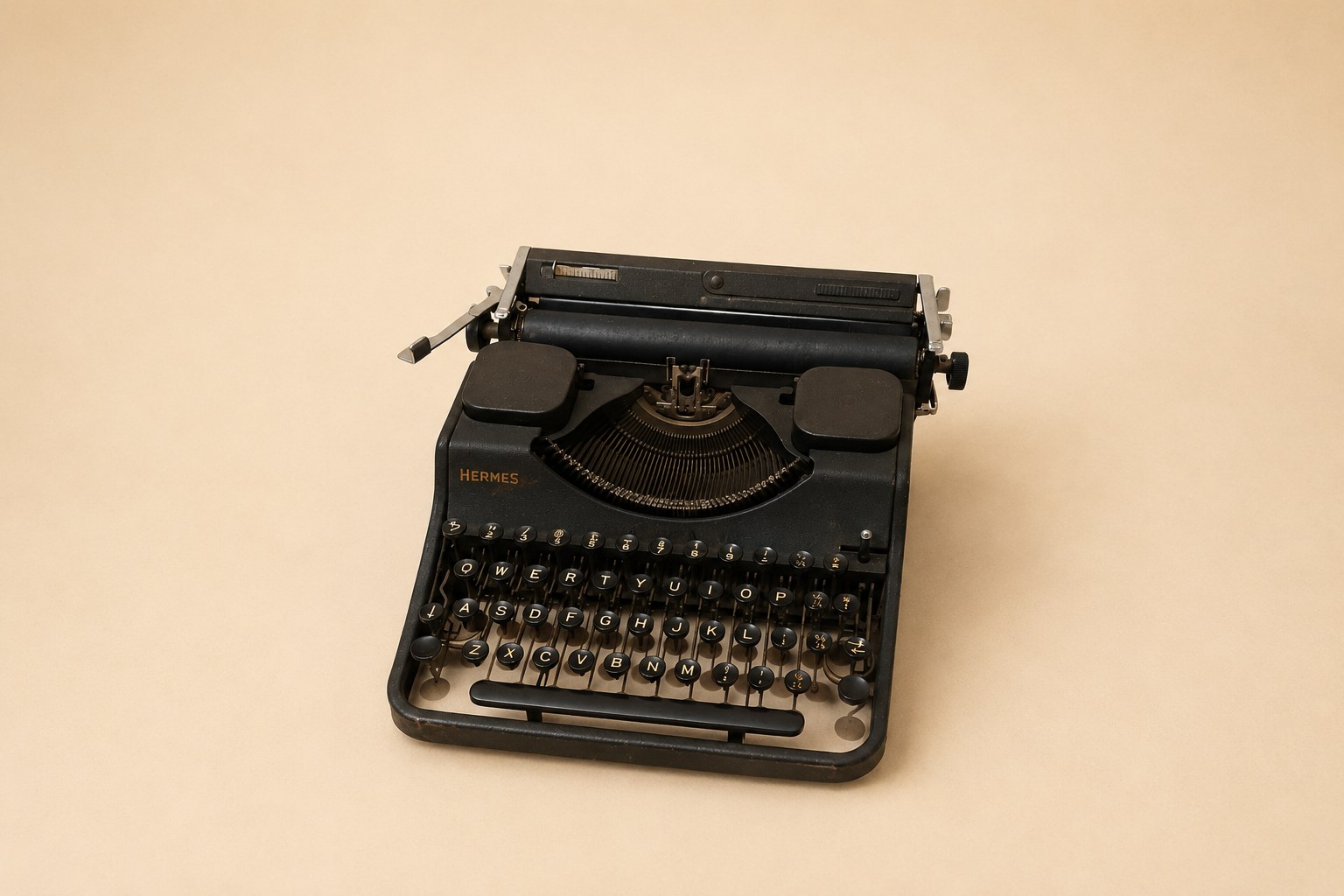
A Swiss precision portable built in wartime (c.1939–1945) by Paillard of Yverdon, with a rare professional fraction keyboard, its original case and instruction booklet, and the label of a London dealer founded in 1884.
View object →
Then, in 1943, Macmillan and Oxford University Press reprinted the Maude translation of War and Peace: Tolstoy's vast novel of Napoleon's doomed 1812 invasion of Russia, reissued in London at the very height of another German invasion of Russia, fold-out map of the 1812 campaign and all. British readers were reaching for a 130-year-old story to decode the morning's headlines from the Eastern Front — and history, with its grim sense of rhyme, was obliging them. The copy even carries the rubber stamp of a Belfast bookseller, placing it in a city the Luftwaffe had blitzed only two years before.
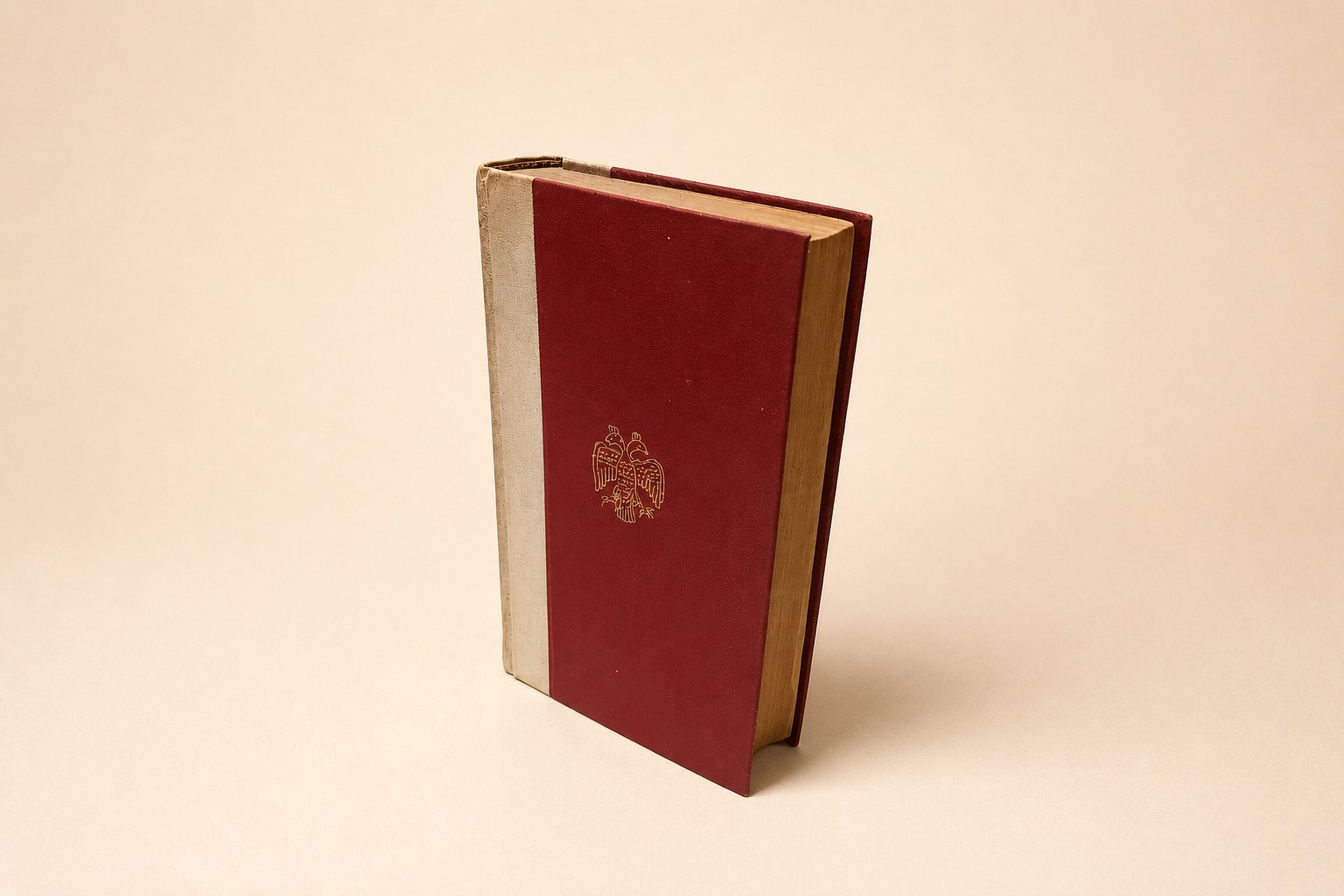
Tolstoy's epic of the 1812 invasion, printed in Britain in 1943, while history repeated itself outside Moscow. The Tolstoy-endorsed Maude translation on wartime paper, with the invasion fold-out map intact.
View object →None of these objects set out to document a war. That is exactly their power.
That is the whole point of them. A weapon documents war on purpose, and we discount it accordingly — of course a rifle remembers the front. But a children's prize, an office machine, a sitting-room novel have no such agenda, and so when they turn out to be saturated with war too, the evidence is incorruptible. Total war is called total precisely because it soaks into everything, even the gentlest categories of made things, leaving dates and marks and routes that a collector can read a century later like the rings inside a felled tree — counting, in the quiet grain of ordinary objects, the years the whole world was on fire.