Opening
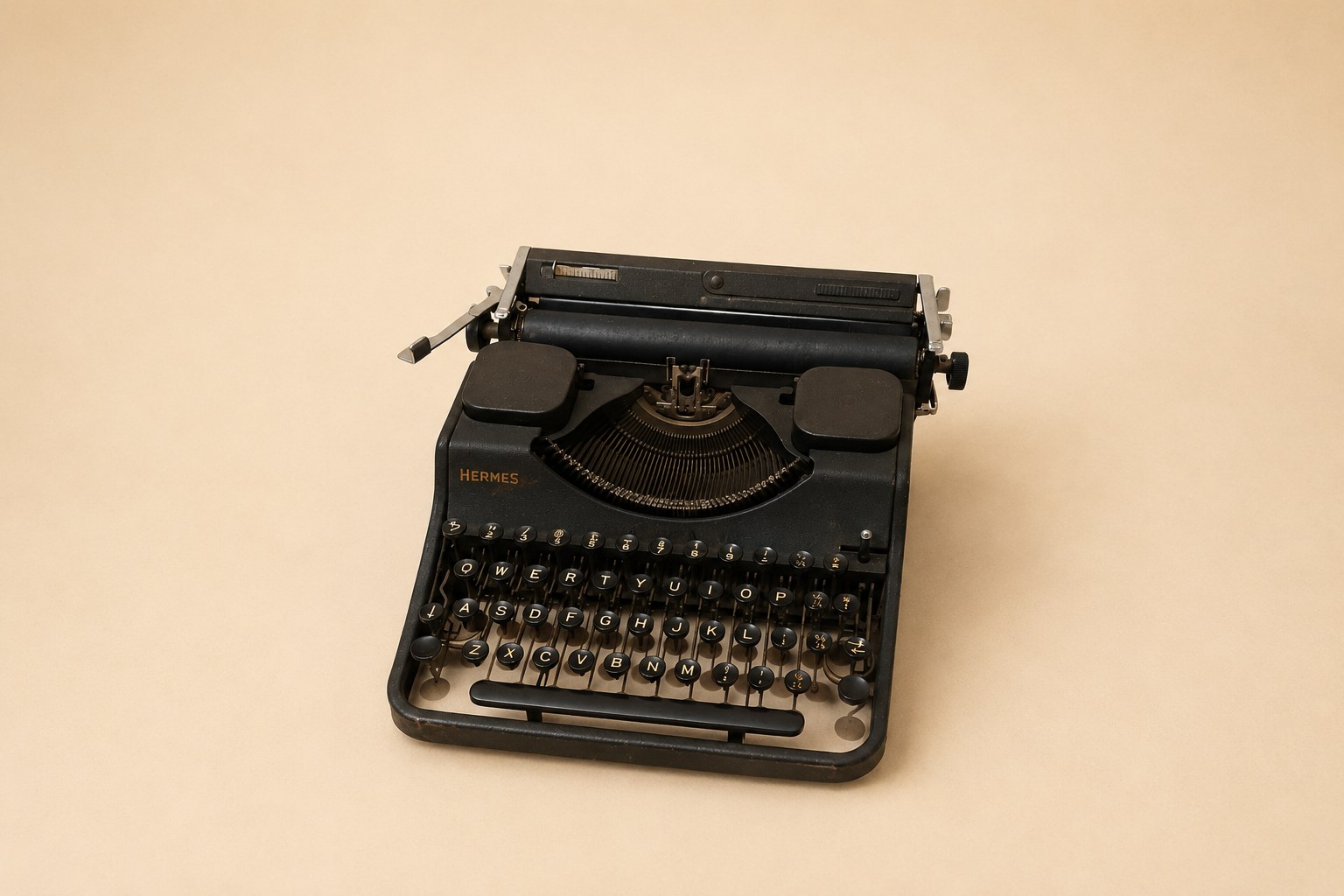
Most typewriters were built to write letters. This one was built to write measurements. Look closely at its keyboard and you find something almost no portable of its era carries: dedicated keys for ½, ¼, ¾, ⅝, ⅞, and ⅛: a full set of fractions, ordered at extra cost by someone whose daily work ran in quantities and dimensions rather than sentences. And it was built in Switzerland, in the middle of the Second World War, by a factory quietly making precision civilian machines while the rest of Europe made weapons.
The Object
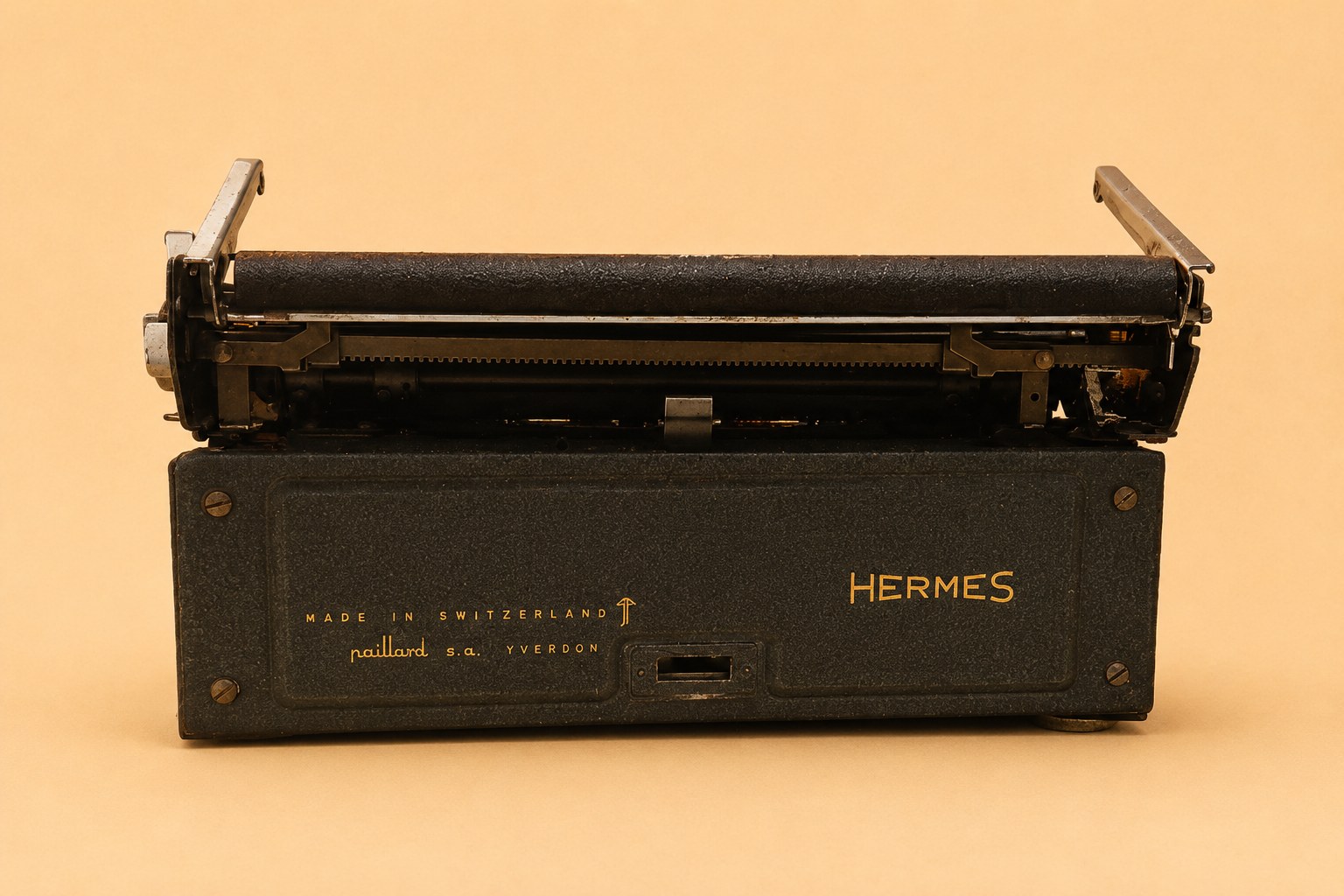
The Hermes Media is a mid-sized portable mechanical typewriter, made by Paillard S.A. of Yverdon-les-Bains, Switzerland, and this example survives in its original dark metal carrying case. The engineering is quietly clever: the machine sits on a base plate secured by three screws, and its four rubber feet seat into leather-lined holes in the case floor, so the mechanism travels without rattling itself to pieces. HERMES stands in raised lettering across the top; the rear panel carries MADE IN SWITZERLAND / paillard s.a. YVERDON, cast into the body itself and repeated on an affixed plate.
The QWERTY keyboard is extended far beyond the standard set: the six fraction keys, mathematical + and =, a pound sign (£), and an underscore. A three-position switch controls the two-colour ribbon: black, stencil (ribbon disengaged), and red. The paper bail carries transparent card holders for typing on cards and labels, a feature absent from simpler portables. The serial number stamped under the base reads 2018220. Set against the Typewriter Database's Hermes serial records, which bracket confirmed examples either side of it, this places manufacture at approximately 1939 to 1945, a dating derived by interpolation between recorded serials rather than from a factory ledger, but a reasonably firm one.
The Maker
Paillard is one of the great names of Swiss precision engineering, with roots in the early nineteenth century as a family firm making watch components and music box mechanisms: a century of miniature mechanics before it ever built a typewriter. The first machines under the Hermes name appeared in 1923, named for the fleet-footed messenger god. The portable line made the company famous: the Hermes Baby of 1935 became one of the best-selling ultra-portables ever made, later carried by writers from John Steinbeck to Sylvia Plath, while the larger Hermes 2000 earned a reputation as one of the finest full-featured portables of its day. The Media, introduced in 1936, sat between them: a lighter, more affordable relative of the 2000 with the same fundamental Swiss build quality. The line's descendant, the Hermes 3000 of 1958, became a cult object among novelists, Jack Kerouac among them.
Paillard's other claim to history is the Bolex 16mm film camera, standard equipment for documentary and experimental filmmakers worldwide. One company, two instruments for recording human experience, words and images, both built to outlast their owners.
The World It Came From
The serial dating places this machine's manufacture squarely inside the Second World War. Switzerland's neutrality meant the Yverdon factory went on building civilian machines to peacetime standards while manufacturing across the rest of the continent was conscripted into war production. A precision portable typewriter leaving a European factory in, say, 1942 is a genuinely strange object: a small island of business-as-usual in a continent at war. How and exactly when it crossed to England is not documented; what is certain is where it ended up being sold.
The machine carries the label of TAYLOR'S TYPEWRITER CO. LTD., 74 Chancery Lane, London — according to Grace's Guide, a firm established in 1884, making it one of Britain's longest-running typewriter dealers. By the time this Hermes passed over its counter, Taylor's had been selling writing machines on the same legal-quarter street for over half a century.
This Copy
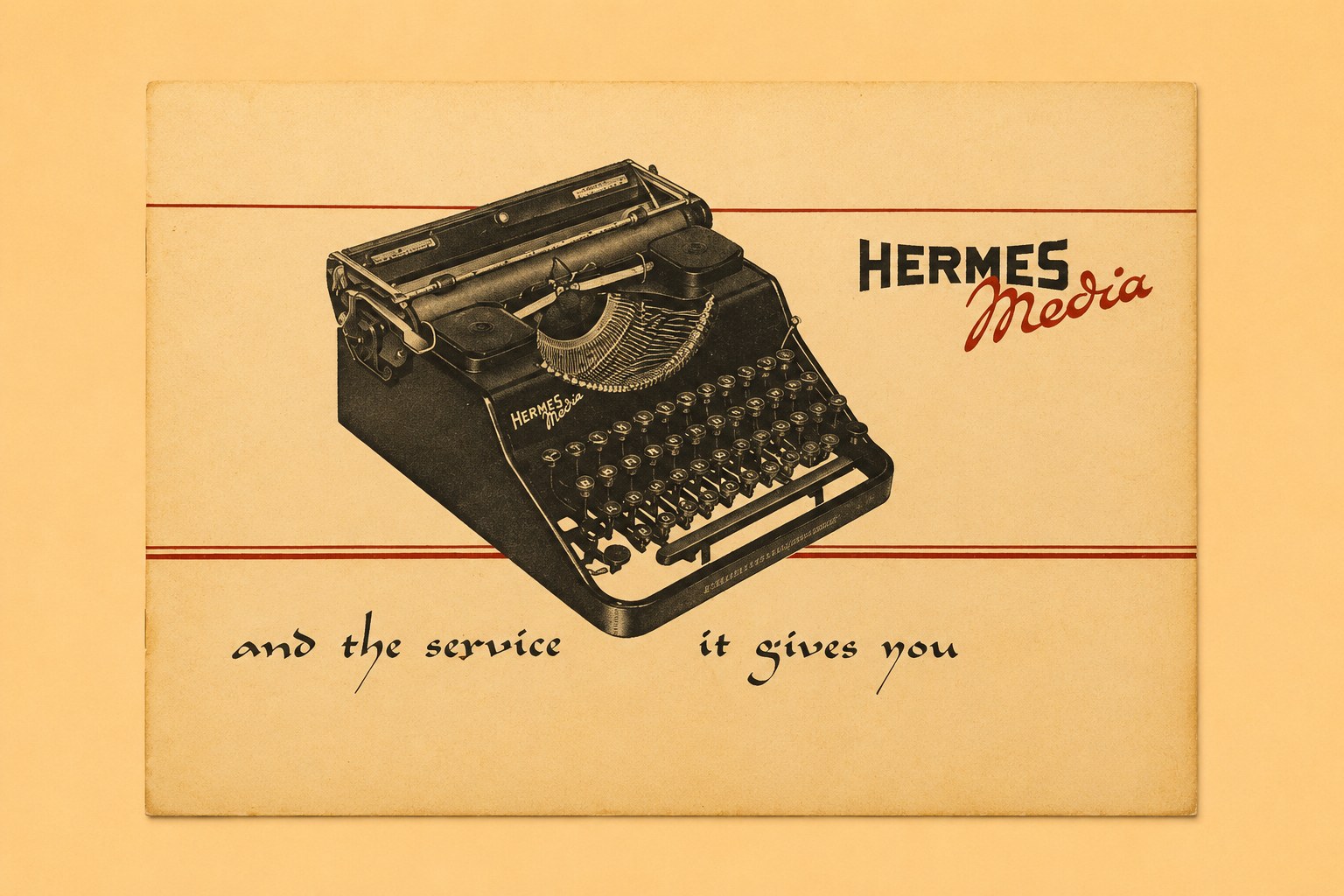
Three things make this individual machine more interesting than the model alone. First, the fraction keyboard: an extra-cost option specified for professional work involving measurements (engineering, commerce, surveying), which means this particular machine was ordered with a purpose, though whose purpose is now beyond recovering. Second, the original instruction booklet (No. 501, English edition, printed in Switzerland by Paillard) survives with it; such booklets were usually lost within a few years, and its survival here is uncommon. Third, the Taylor's label appears in three places (keyboard surround, case lid, and booklet), which together confirm that case and booklet are original to this machine, not later marriages.
Mechanically, the machine needs attention: the carriage escapement is not advancing correctly, the ribbon is absent, and several keys are sticky. These faults are consistent with long-term storage rather than abuse, and all are within the competence of a typewriter technician to put right.
Why It Matters
The Hermes Media was never the flagship (that honour belonged to the 2000 and later the 3000), but that is part of its appeal: it is the machine that put Swiss precision within reach of the ordinary professional. This example compounds the interest at every turn. It is a wartime survivor from a neutral country; a technical-keyboard machine ordered for serious work; a rare case where machine, case, booklet, and dealer history all survive together; and a link in a London retail lineage running back to 1884. Most old typewriters are anonymous. This one carries its biography stamped, labelled, and printed all over itself.
References
- Hermes Typewriter Serial Number Database, typewriterdatabase.com
- History of the Hermes Typewriter, Classic Typewriter Co.
- Will Davis, European Typewriters: Switzerland, willdavis.org
- Hermes Baby, Museum für Gestaltung Zürich eGuide
- Paillard S.A., Wikipedia
- Hermes 3000, Wikipedia
- Bolex, Wikipedia
- Taylor's Typewriter Co., Grace's Guide
- Swiss neutrality, Wikipedia
- Yverdon-les-Bains, Wikipedia