Pick up the phone in your pocket and consider, for a moment, everything it quietly does: it calculates, it writes, it forecasts the weather, it takes photographs. Now wind that single black slab back a hundred years and watch it shatter into objects — wood, steel, glass, celluloid, brass — each one heavy, each one dedicated to a single task, each one demanding a little skill from its owner. Four of those objects sit in this collection, all made within thirty years of one another. Together they are a smartphone, disassembled across a century.
To calculate. An A.W. Faber "Castell" 360 slide rule from Bavaria, made between about 1928 and 1934, celluloid faces over a pearwood body, protected by the German patents D.R.P. 206428 and 365637. Before the electronic calculator there was this: a logarithmic ruler that multiplied, divided, and found roots by the sliding of one scale against another. Engineers carried them the way their grandchildren carry phones, clipped to the belt or slid into the jacket. Every bridge, every engine, every dam of the period was conjured into being on scales exactly like these.
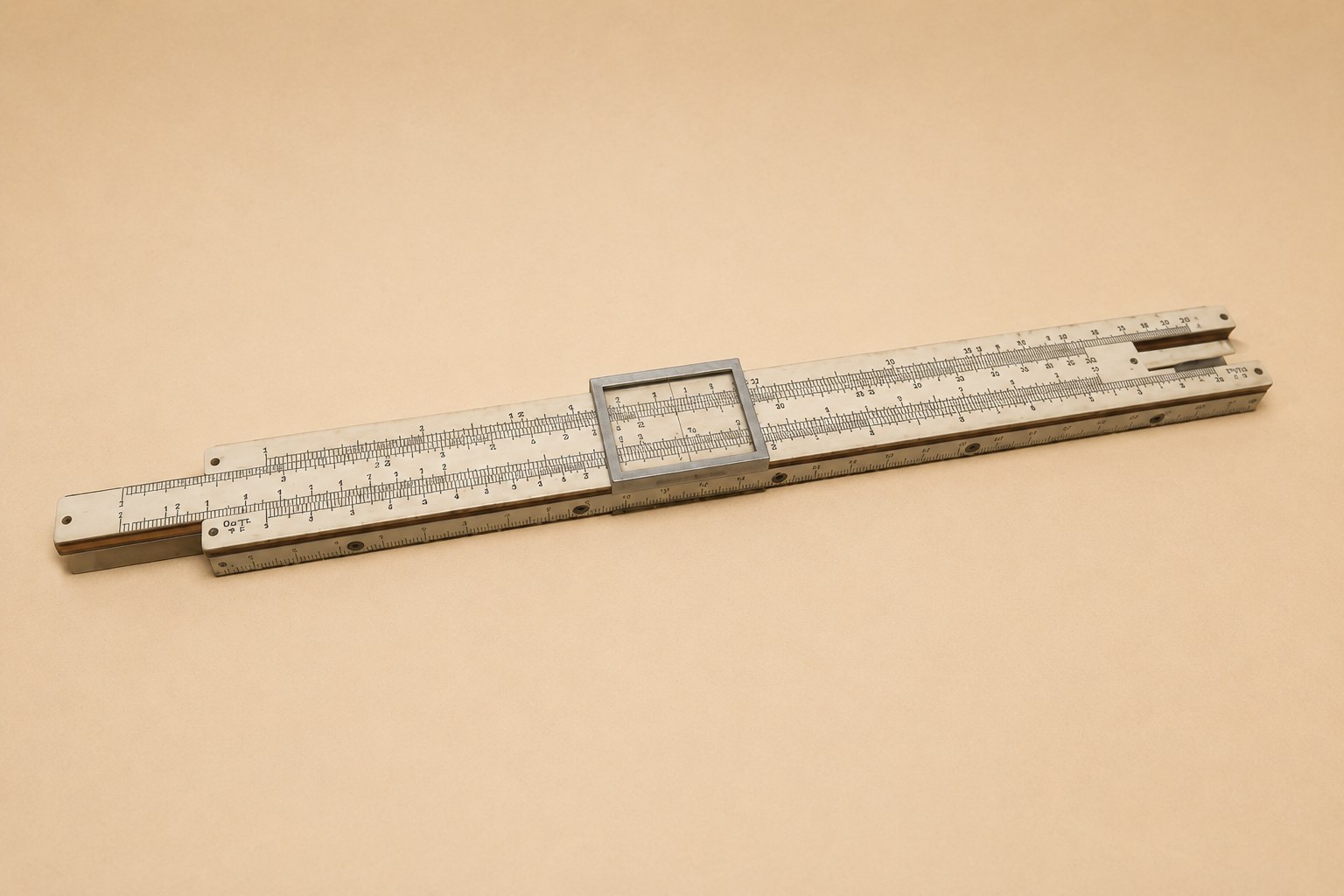
Before calculators, this is how the world did its maths. A celluloid-faced pearwood Mannheim slide rule by A.W. Faber "Castell", made in Bavaria c.1927–1934 for the English-speaking export market, with patented anti-warp bracing and its original glass cursor.
View object →
To write. A Hermes Media portable typewriter by Paillard S.A. of Switzerland, built around 1939–45 and retailed by Taylor's Typewriter Co. of 74 Chancery Lane, deep in London's legal quarter — which is exactly why it wears an extended professional keyboard complete with dedicated fraction keys, the tools of a clerk drafting contracts. Serial number 2018220, and remarkably it still has its metal case and its instruction booklet: a working machine that managed to keep its papers for the better part of a century.
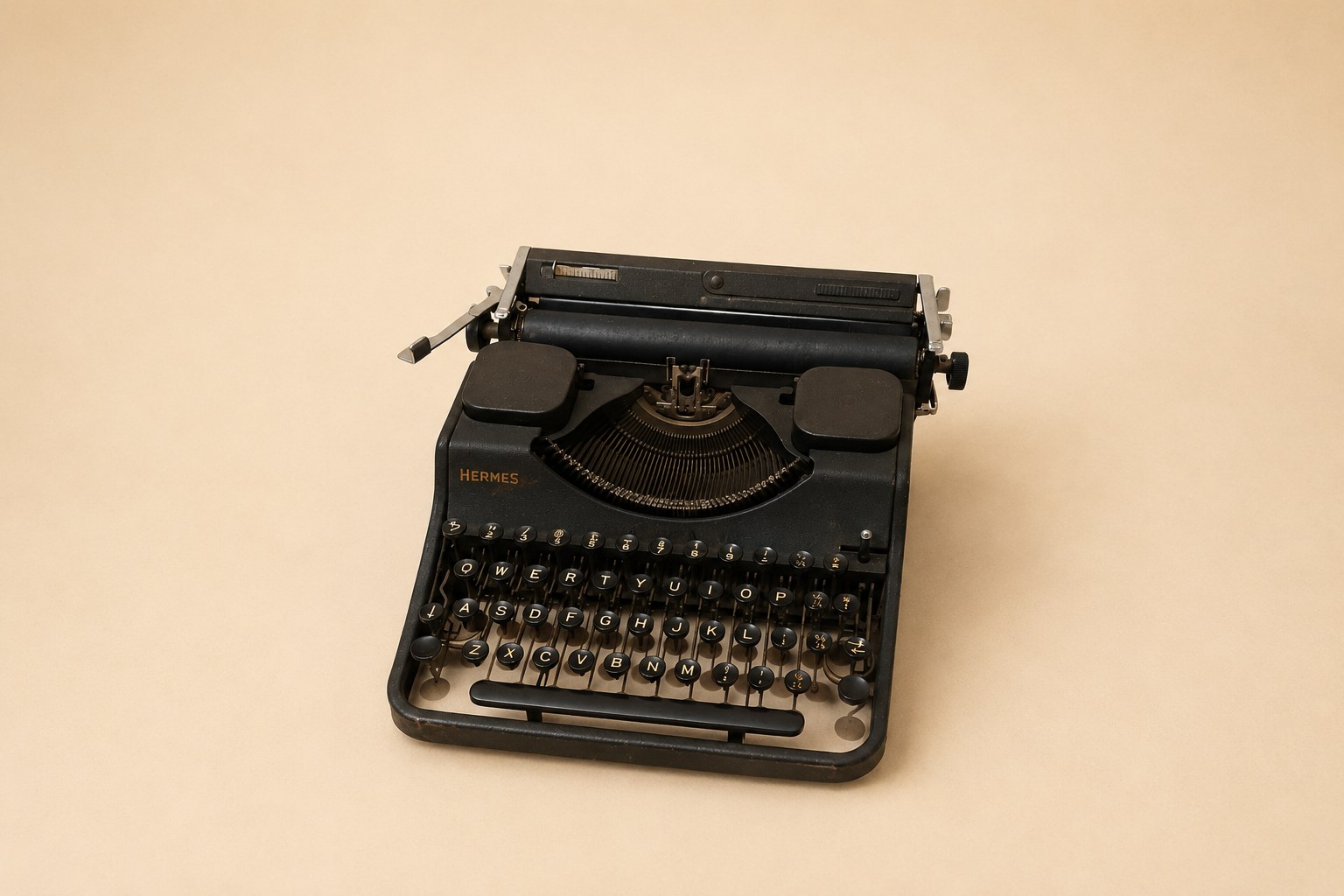
A Swiss precision portable built in wartime (c.1939–1945) by Paillard of Yverdon, with a rare professional fraction keyboard, its original case and instruction booklet, and the label of a London dealer founded in 1884.
View object →To forecast. A Shortland Brothers wall barometer and thermometer of 1947 in an Art Deco oak case with a chrome bezel and the firm's patented dual-hand SB forecasting dial. You set one hand by memory and read the coming weather in the gap that opened between it and the other. The brass plaque screwed to its face — presented by Saltash United F.C., 22 November 1947 — tells you exactly how such an instrument was regarded: serious enough to be a public gift, the sort of thing a community handed a man to honour him properly.
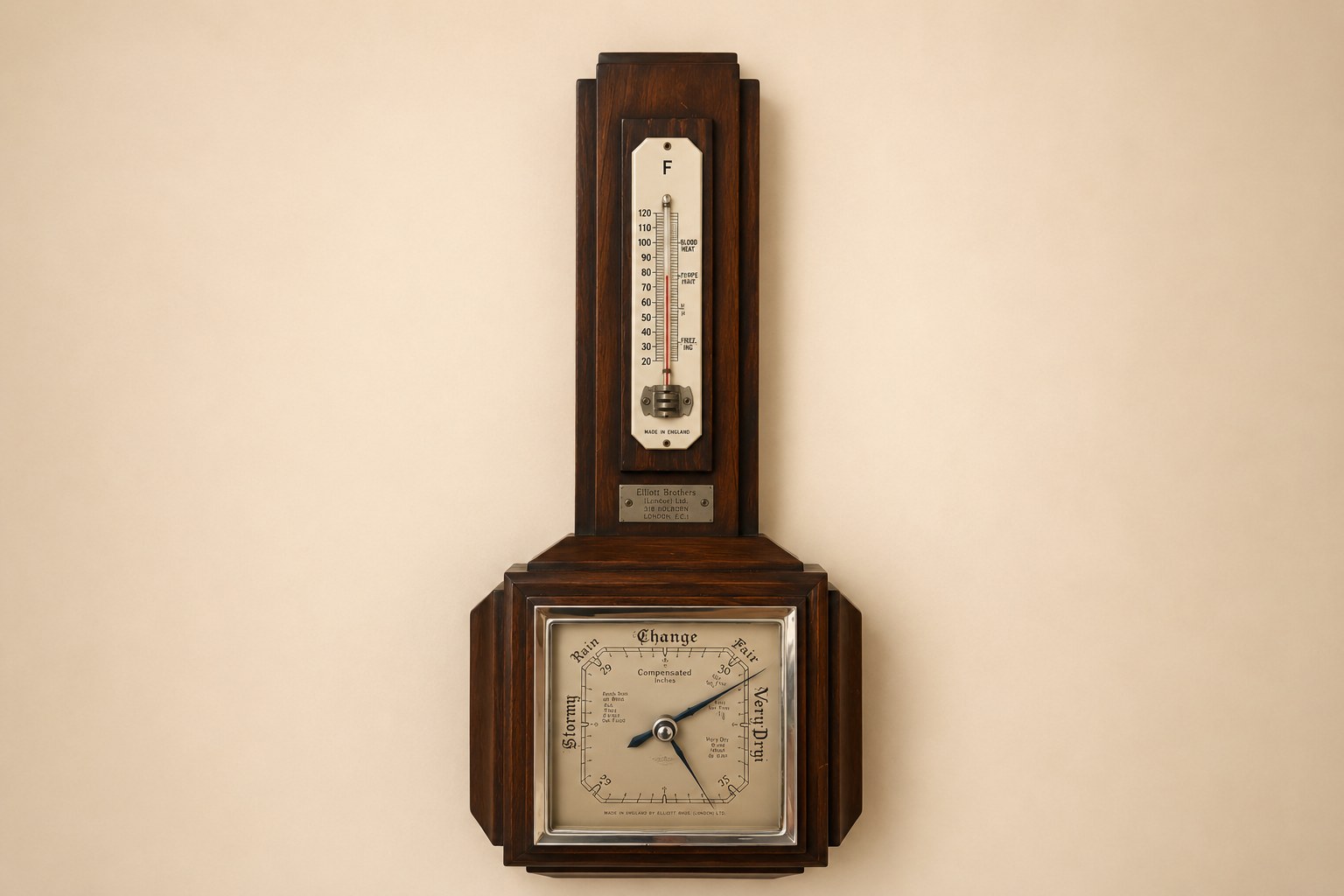
An Art Deco oak weather station with a patented dual-hand forecasting dial, presented by a Cornish football club to one of its own on 22 November 1947, name and date still polished into the brass.
View object →To see. A Ross Ensign Ful-Vue Super of 1954, the only model in the Ful-Vue range built for 620 film. Cast alloy body, a 75mm meniscus lens fixed forever at f/11, and that wonderful oversized brilliant finder on the top plate that let an ordinary parent, glancing down at waist level, compose a child's photograph without a scrap of expertise.
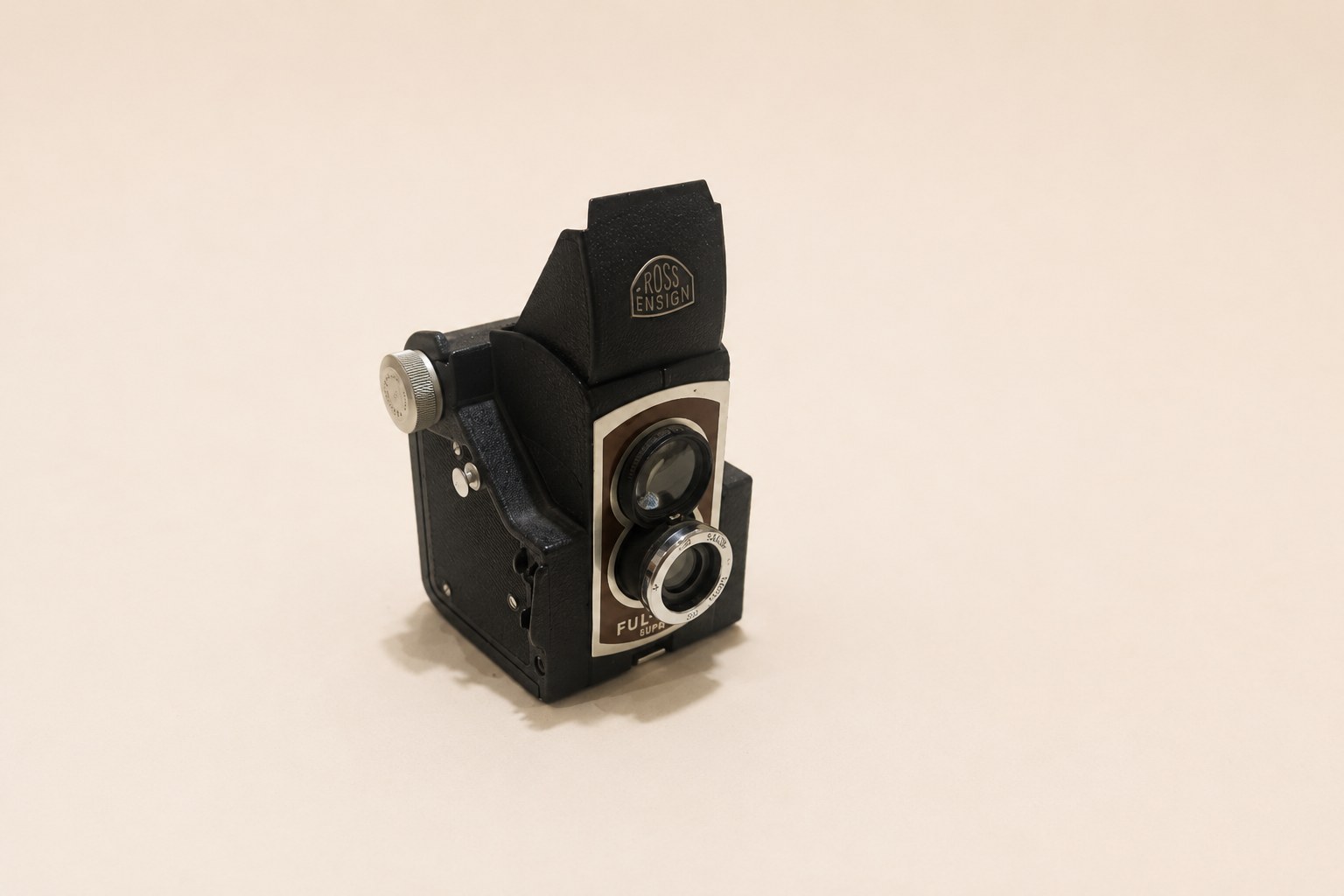
The camera that taught Britain to look down, not through: a 1954 Ross Ensign pseudo-TLR with a glowing waist-level finder, one shutter speed, and a lineage reaching back to Daguerre's London licence of 1839.
View object →Together they reconstruct the working day of the analogue century — measured, typed, forecast, and photographed.
None of these four is rare the way the Porcacchi map on another shelf is rare. Their value is not in scarcity but in company. Apart, they are four old machines. Together they rebuild an entire vanished competence — the daily, hands-on fluency of a world that calculated without electricity, wrote without a screen, read the sky without a satellite, and made pictures one careful frame at a time. This is the Instruments of Progress thread in miniature: the everyday made obsolete, and kept.