Mid-Century

Ensign Ful-Vue Super Camera

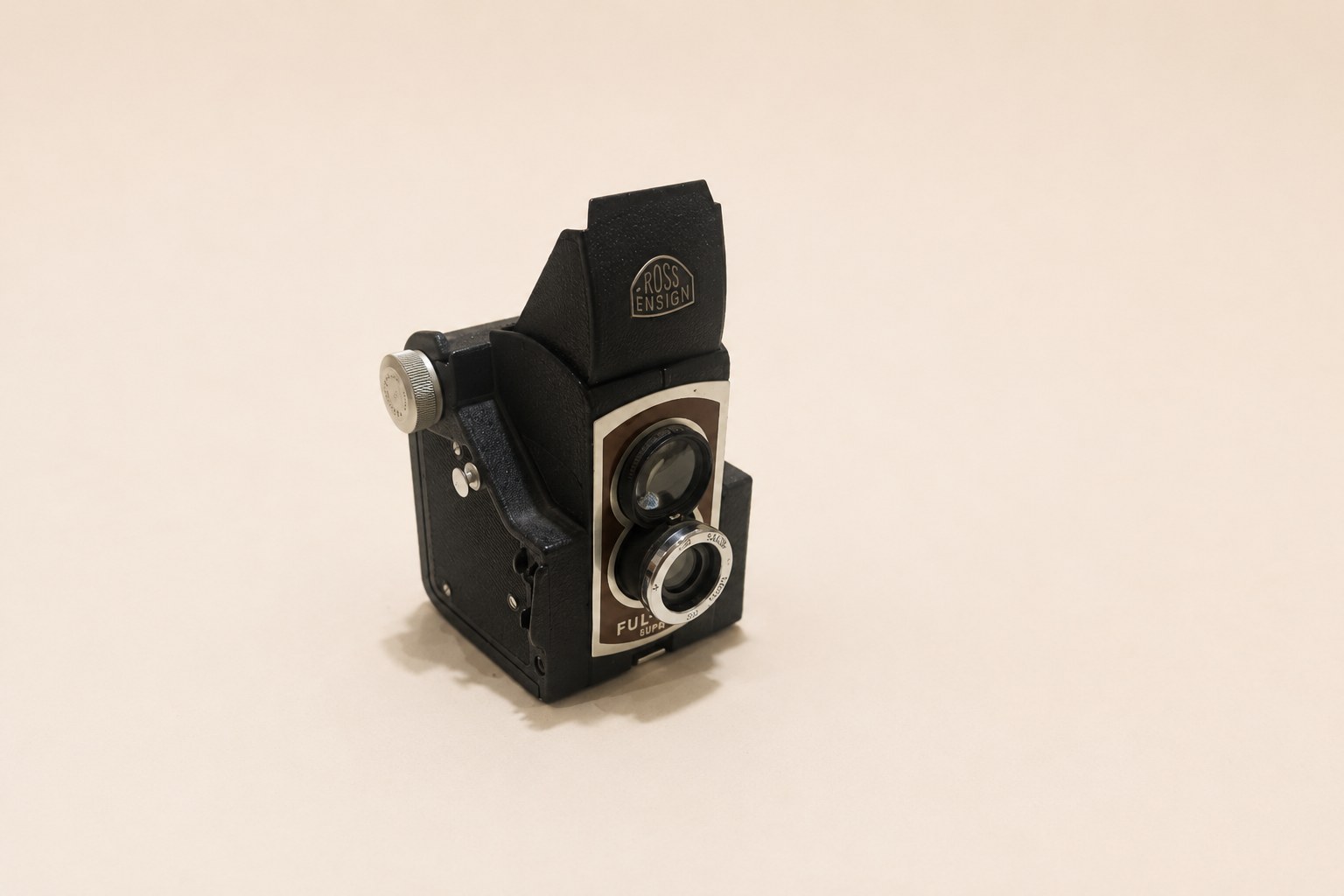
A 1954 Ross Ensign Ful-Vue Super medium-format pseudo-TLR camera, the only model in the Ful-Vue range to use 620 roll film. Cast alloy body with pressed steel back, 75mm meniscus lens at fixed f/11, single-blade shutter at approximately 1/50s, and the Ful-Vue's signature large brilliant top-mounted viewfinder. Interior mould codes P2807 BDC and P2804 BDC. Mechanisms operate as expected.

Year
1954 · c.1954
Era
Mid-Century
Maker
Ross Ensign Ltd., London, England
Origin
England
Materials
Cast alloy body, pressed steel back and viewfinder hood, meniscus lens, 620 roll film format
Condition
Good
PhotographyOptical

Opening

The Ful-Vue Super is a camera you can read at a glance. One large lens on the front. A vast brilliant viewfinder on the top — almost the size of the picture itself — into which you peer straight down, seeing the world in a glowing square of light. One shutter lever. Three focus distances. No exposure settings to worry about. Point it at something, look down into the finder, squeeze the trigger. This was the entire act of photography for millions of British families in the 1950s, and for most of them it was the only camera they would ever own.

The Object

This is a Ross Ensign Ful-Vue Super, manufactured in England in 1954. It is the final and most refined model in the Ful-Vue range, and the only one in that range to use 620 roll film rather than 120. The body is cast alloy with a pressed steel back and bottom section, which removeas as a single piece for film loading. The overall dimensions are 85 x 100 x 87 mm and the camera weighs approximately 434 grams. Colour is black with bright metal trim on the front plate and viewfinder surround.

The front plate is flat and extends in a single continuous panel around both the taking lens at the bottom and the viewfinder objective lens above it, giving the Super a cleaner, more unified face than the earlier Ful-Vue II. The viewfinder hood on top is pressed steel and collapsible, folding down flat against the camera body for storage, an improvement over the fixed hood of the Ful-Vue II. The tripod bush is located on the base.

Inside the body, cast mould reference codes are visible on the interior walls: P2807 BDC on one wall and P2804 BDC on the opposite wall. These are tooling and die-casting batch reference numbers, standard practice in British precision manufacturing of the period, and are not serial numbers of the finished camera.

The Maker

The lineage behind this camera stretches back to the very beginning of photography in England. In 1834, George Houghton joined the Frenchman Antoine Claudet to manage a glass warehouse at 87 High Holborn, London, trading as Claudet and Houghton. In 1839, weeks after Louis Daguerre announced the daguerreotype process to the world, Claudet secured a licence directly from Daguerre and began operating London's first photographic portrait studio, while Houghton turned to selling daguerreotype supplies. The firm was present at the birth of photography in Britain and never left the industry.

Over the following decades the business passed through successive generations and partnerships, becoming George Houghton and Sons by 1892 and making its first camera in 1893. In 1926 Houghtons merged with W. Butcher and Sons to form Houghton-Butcher Manufacturing Co., one of the largest photographic manufacturers in Britain. In 1930 a distribution arm called Ensign Ltd. was established to sell the cameras under the Ensign brand name. After the Second World War, having merged with Barnet film producers, the company became Barnet Ensign, then Barnet Ensign Ross in 1948 when it absorbed the prestigious Ross optical firm, and finally Ross Ensign Ltd. in 1954, the name under which this camera was made. The company ceased trading in 1961, a casualty of cheap Japanese 35mm cameras flooding the British market.

Ross of London brought significant optical heritage to the merger. Founded by Andrew Ross in the 1830s, the firm had supplied precision lenses for telescopes, microscopes, and cameras to the scientific and photographic community throughout the Victorian era, and the Ross name on the lens of a camera carried genuine prestige.

The Ful-Vue Range

The original Ful-Vue was introduced in 1939, designed by Kenneth Corfield and manufactured by Houghton-Butcher. Its defining innovation was its viewfinder: instead of the tiny direct-vision finder or ground-glass back common on box cameras of the period, the Ful-Vue placed a large brilliant reflex finder on the top of the camera, the full width of the body, into which the photographer looked straight down to see a bright, well-illuminated image nearly the size of the final print. This was a feature previously associated only with expensive professional twin-lens reflex cameras like the Rolleiflex, and the Ful-Vue brought it to a mass-market price point.

The camera was a box camera in engineering terms but a pseudo-TLR in appearance and use. It had no aperture control, a single shutter speed, and a simple meniscus lens. It shot 6x6 cm squares on 120 roll film, twelve frames per roll. It required no technical knowledge to operate and its large brilliant viewfinder was genuinely easy to use, particularly for children. It was sold for years as an ideal first camera and is estimated to have sold over a million units across all models, making it one of the best-selling British cameras of all time.

The range evolved through several versions: the original 1939 model, a post-war reissue, the Ful-Vue II with synchro-flash and minor improvements, and finally in 1954 the Ful-Vue Super, which introduced the cast alloy body, flat front plate, collapsible steel hood, removable back-and-bottom for easier film loading, and a switch to 620 film. Production of the Ful-Vue Super ran from 1954 to approximately 1959.

Technical Specification

The taking lens is a 75mm meniscus with a fixed aperture of f/11. The focus ring on the front bezel moves the entire lens forward and backward relative to the film plane, offering three marked distances: 2 metres / yards, 3 to 5 metres / yards, and 6 metres to infinity. At f/11 the depth of field is generous across all three settings, and in practice the distinction between the closer settings matters only for subjects under three metres from the camera. The instruction booklet's note that "the lens is designed for all distances" is broadly accurate for outdoor and general indoor use.

The shutter is a single-blade return type, giving an instantaneous exposure of approximately 1/50 second at the "I" (Instantaneous) setting. A "B" (Bulb) setting holds the shutter open for as long as the lever is depressed, enabling time exposures with the camera on a solid support. The shutter release is a lever on the side of the camera, squeezed downward by the forefinger. Two flash synchronisation terminals are provided on the side panel: a push socket and a screw socket, enabling connection to a range of flash units available at the time.

Film advance is manual, via a knurled knob on the side of the camera. Frame numbering is read through a closeable red safety window on the back. The film format is 620 roll film, producing twelve 6x6 cm square negatives per roll. The 620 spool is physically slightly narrower than a 120 spool, and while the film stock is identical in width, standard 120 film cannot be loaded directly without re-spooling onto a 620 spool.

The 620 Film Format

620 film was introduced by Kodak in 1931 as a nominally improved alternative to 120 film. The film itself is identical in width (62 mm) and image area, but the spool it is wound on is slightly narrower in diameter, allowing cameras to be made more compact. In practice 620 film never displaced 120 as the professional standard, and throughout the 1940s and 1950s the two formats ran in parallel, with 620 cameras sold primarily to the amateur and snapshot market. Kodak discontinued 620 film in 1995, leaving cameras that require it dependent on re-spooled 120 stock.

The Ful-Vue Super is one of the few British cameras of the period to have adopted 620. The decision was likely commercial rather than technical: Kodak actively promoted 620 cameras and film as a system, and alignment with Kodak's amateur ecosystem made distribution easier. This camera can still be used today by re-spooling standard 120 film, which is readily available, onto a 620 spool in a darkroom or changing bag.

The Viewfinder

The large brilliant viewfinder is the camera's defining feature and the source of its name. It functions on the same optical principle as a twin-lens reflex camera: a separate objective lens on the front of the camera projects the scene onto a mirror, which redirects the image upward through a ground glass screen into the collapsible hood above. The photographer holds the camera at waist or chest height and looks straight down into the hood to compose the image.

The result is a viewfinder that shows a bright, upright image almost the full size of the finished print, with natural perspective and easy subject tracking. It is considerably more usable than the postage-stamp viewfinders of contemporary box cameras, and the experience of composing through it is qualitatively different from holding a camera to the eye. The image is laterally reversed left-to-right, which takes brief adjustment, but for static subjects and casual snapshot photography the reversal is not a practical obstacle. The Ful-Vue Super's hood, being collapsible, provides better shade exclusion than the earlier fixed hood, improving viewfinder brightness in direct sunlight.

Significance

The Ensign Ful-Vue Super sits at the end of a long line of democratic cameras, instruments designed not for professionals but for people who simply wanted a record of their lives. The company behind it traced its roots to the first weeks of photography in Britain in 1839, and the camera it produced in 1954 distilled more than a century of accumulated knowledge about what ordinary people needed from a camera into the simplest possible form. One lens, one speed, a brilliant window to look through, and a squeeze of the finger.

The 620 film format it required is now obsolete, but the camera's mechanisms remain fully operational. It can still take photographs. Load a re-spooled roll, carry it outdoors into reasonable light, set the focus to six yards to infinity, and squeeze the lever. The shutter will fire at approximately 1/50s. The meniscus lens will project a softly rendered, pleasingly imperfect image onto the film. The result will look exactly like the photographs taken with cameras like this one at seaside holidays and garden parties across Britain seventy years ago, because it is the same camera and the same optics.

References

  1. Ross Ensign Ful-Vue Super specifications, Art Deco Cameras
  2. Ful-Vue Super, Camera Go Camera
  3. The Ensign Ful-Vue: The Brit Brownie, Kosmo Foto
  4. Ensign Ful-Vue, Camerapedia
  5. Ensign Ful-Vue (1946), mike eckman dot com
  6. Ensign Ful-Vue, ensignphotographic.com
  7. Houghton and Son (Ensign) Company History, Historic Camera
  8. Houghton-Butcher (Gt. Britain), Graces Guide
  9. Houghton Butcher Ensign History, Photographic Memorabilia
  10. Ensign Ful-Vue Film Camera Review, Ali Warner Photography
  11. 620 Film, The Darkroom
  12. Antoine Claudet, Wikipedia
  13. Louis Daguerre, Wikipedia
  14. Rolleiflex, Wikipedia
  15. Ross optical company, Wikipedia