Books & Literature
England West
The trilogy's longest journey: Thames to Hadrian's Wall through Cotswold wool churches, Shakespeare country, the Marches, and the industrial North. The richest of the three volumes in architectural range (1950).
A Private Archive of Antiques & Historical Objects
Books & Literature
The trilogy's longest journey: Thames to Hadrian's Wall through Cotswold wool churches, Shakespeare country, the Marches, and the industrial North. The richest of the three volumes in architectural range (1950).
The middle volume of the trilogy makes the longest journey. It starts north of the Thames among Chiltern beechwoods and does not stop until it reaches Hadrian's Wall, passing on the way Cotswold wool churches, Shakespeare's Warwickshire, the border castles of the Welsh Marches, Staffordshire's smoking pot-banks, Derbyshire's limestone dales, and the lonely peel towers of Cumberland. No single stretch of England contains more architectural variety, and Jones had spent half a century filling sketch-books with it. In 1950, he opened them.
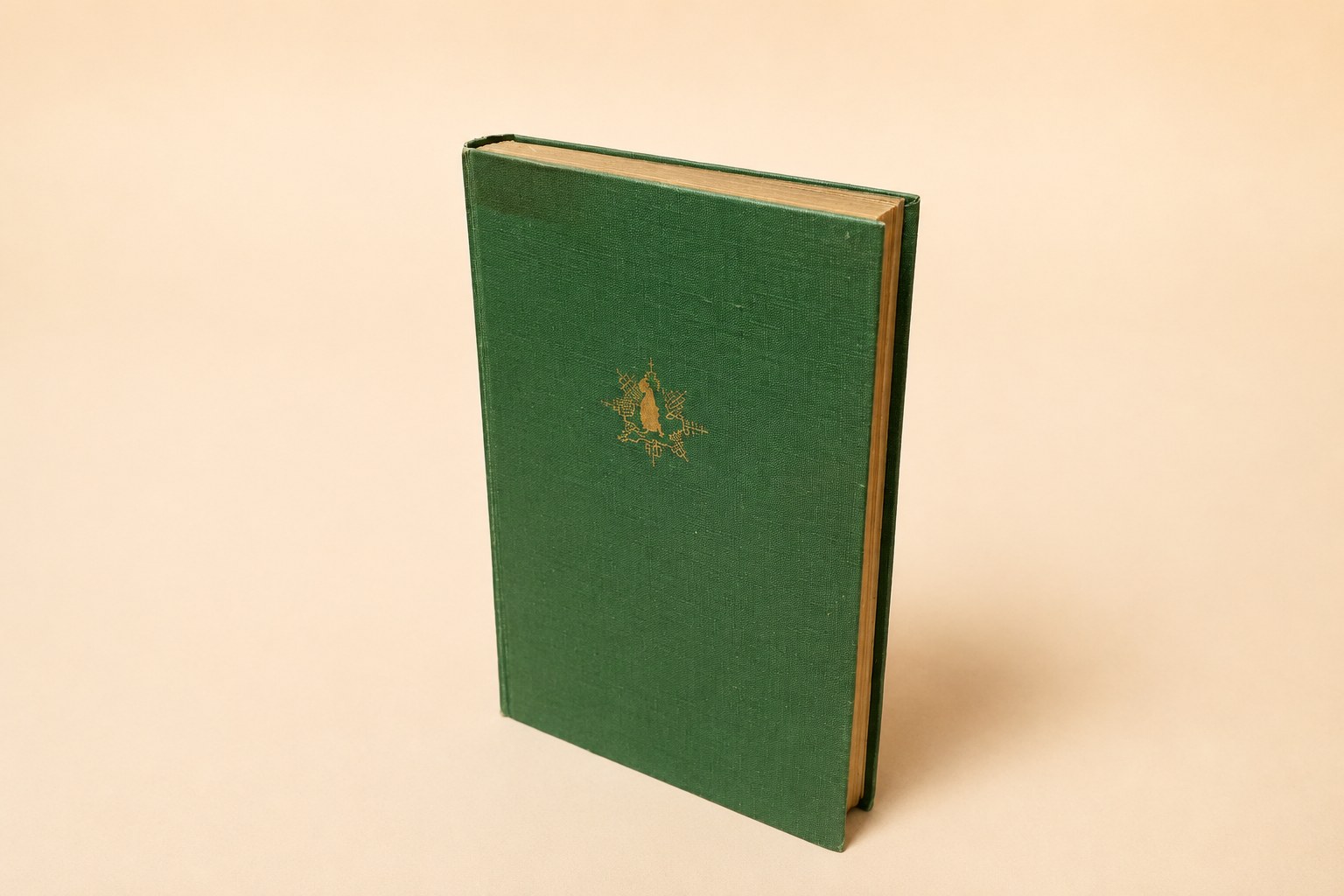
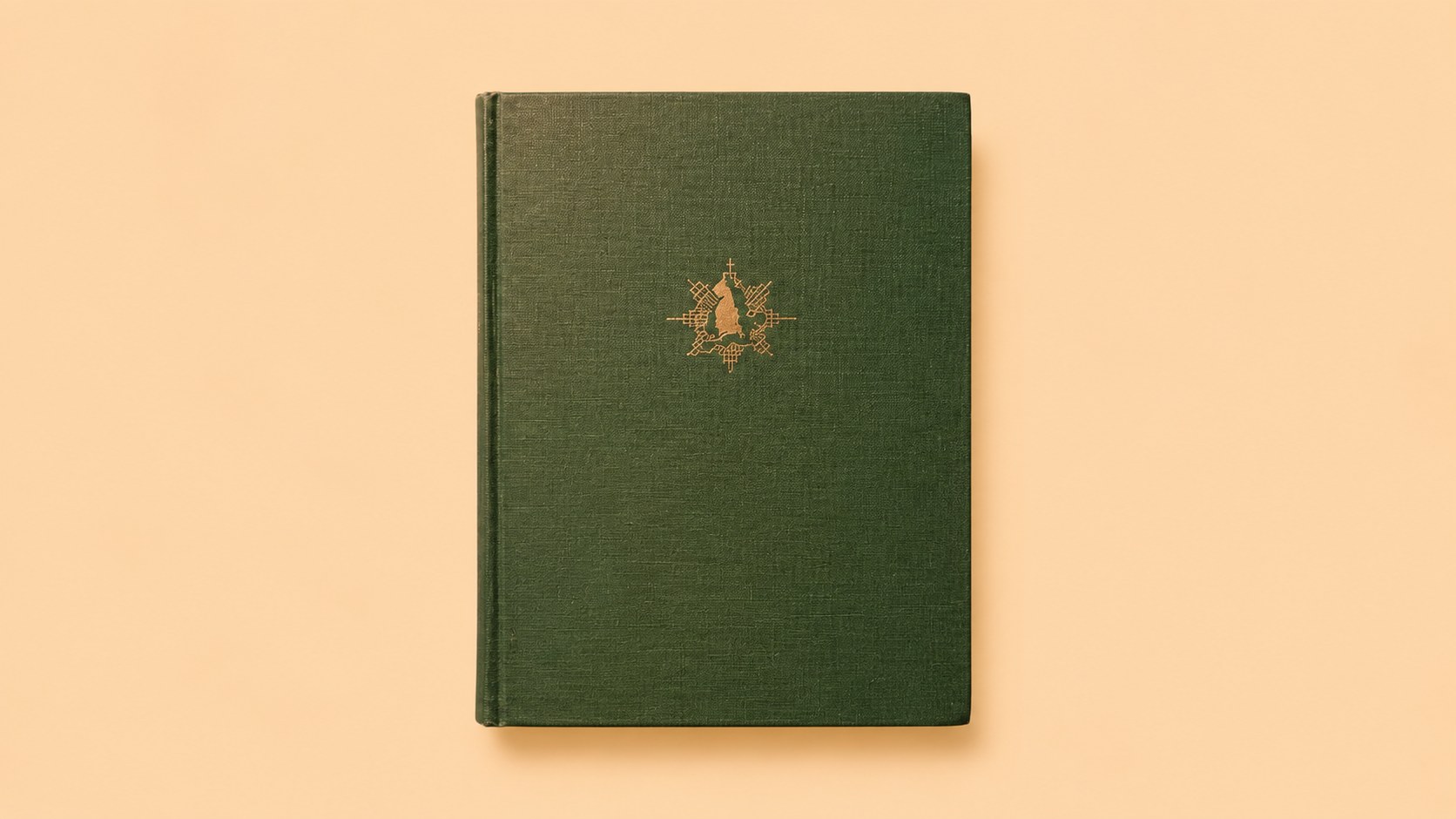
England West is the second volume of Sydney R. Jones's illustrated survey of England, published in 1950 by The Studio Publications of London and New York: a green-cloth, gilt-lettered hardback of around 272 pages, uniform with its companions, printed by William Clowes & Sons with offset plates by Bradford & Dickens, with four hand-drawn regional maps and a full index.
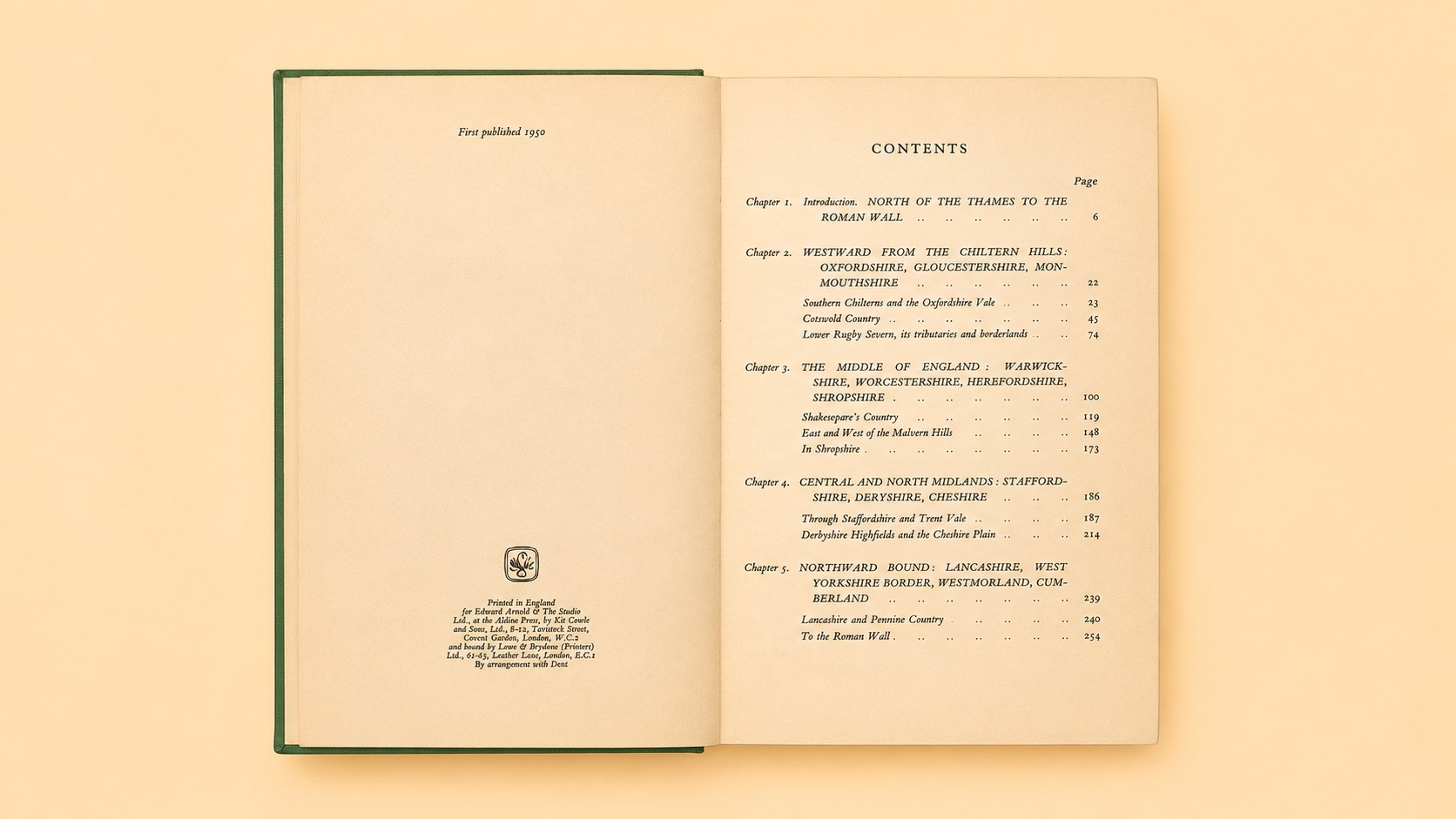
The opening chapter traces one continuous arc from the Thames to the Roman Wall, peeling back the Roman, medieval, Tudor, Stuart, and Georgian layers of the landscape in turn. Then come the set-piece regions: the Cotswolds (Burford, Chipping Campden, Bibury); Shakespeare country around Stratford and Warwick; the Marches towns of Ludlow and Shrewsbury; and the industrial valleys of Staffordshire, which Jones treats with the same seriousness as any abbey. The illustrated parade includes Compton Wynyates (the moated Tudor house he presents as virtually unaltered since Henry VIII) along with Haddon Hall, Hardwick, Chatsworth, Little Moreton Hall, and the timber-framed streets of Nantwich.
Sydney Robert Jones (1881–1966), Birmingham-born and trained at the Birmingham School of Art, spent his life drawing English buildings: as illustrator for The Studio and The Sphere, and as author-artist of books from Old English Country Cottages (1906) to the wartime London Triumphant and Thames Triumphant. His drawings are held in the Victoria and Albert Museum and the Art Institute of Chicago. This title page credits England South before it: the trilogy announcing itself mid-stride.
The split between "West" and "East" England was the publisher's invention, an imaginary line drawn from the Thames to the Tweed, and it handed Jones an impossible brief: make one coherent book out of Cotswold wool money and Roman frontier forts. That he succeeds is the quiet achievement of the volume. His unifying thread is continuity: the way English building grows out of local stone and local trade, whether the trade is wool, salt, coal, or pottery. He records the industrial Midlands and the mill towns without condescension, at a moment in 1950 when Birmingham's expansion and post-war development were actively consuming the countryside he was drawing, which gives the book, like its predecessor, the character of testimony as much as celebration.
This copy is in excellent condition, uniform with its companion volumes, the green cloth and gilt bright. The three volumes sit together in this collection as a complete set, increasingly uncommon as the trilogy is usually found scattered one volume at a time.
England West is widely regarded as the richest of the three volumes in architectural range: nowhere else does Jones move from a medieval fortress to a canal warehouse to an Elizabethan prodigy house within a few pages and make the sequence feel inevitable. It is also the volume where his lifelong double identity, architect's eye and artist's hand, pays off most visibly. As a record of the West Midlands and the North-West on the eve of their great post-war transformation, it has only grown in documentary value since.
Provenance
No inscriptions or ownership marks. Title-page credits England South before it, confirming the 1950 setting. Acquired February 2026 with its two companion volumes as a complete trilogy.
England South
Forty years of sketch-books opened in the year England needed them most: the first volume of Sydney R. Jones's illustrated journey through the southern counties, from London to the very end of Cornwall (1948).
England East
The farewell volume: Jones closes his life's work with a journey from the Thames to the Scottish border, saluting Durham coalminers alongside Northumbrian castles, under an epigraph about ashes and graves (1954).
The Gleam in the North
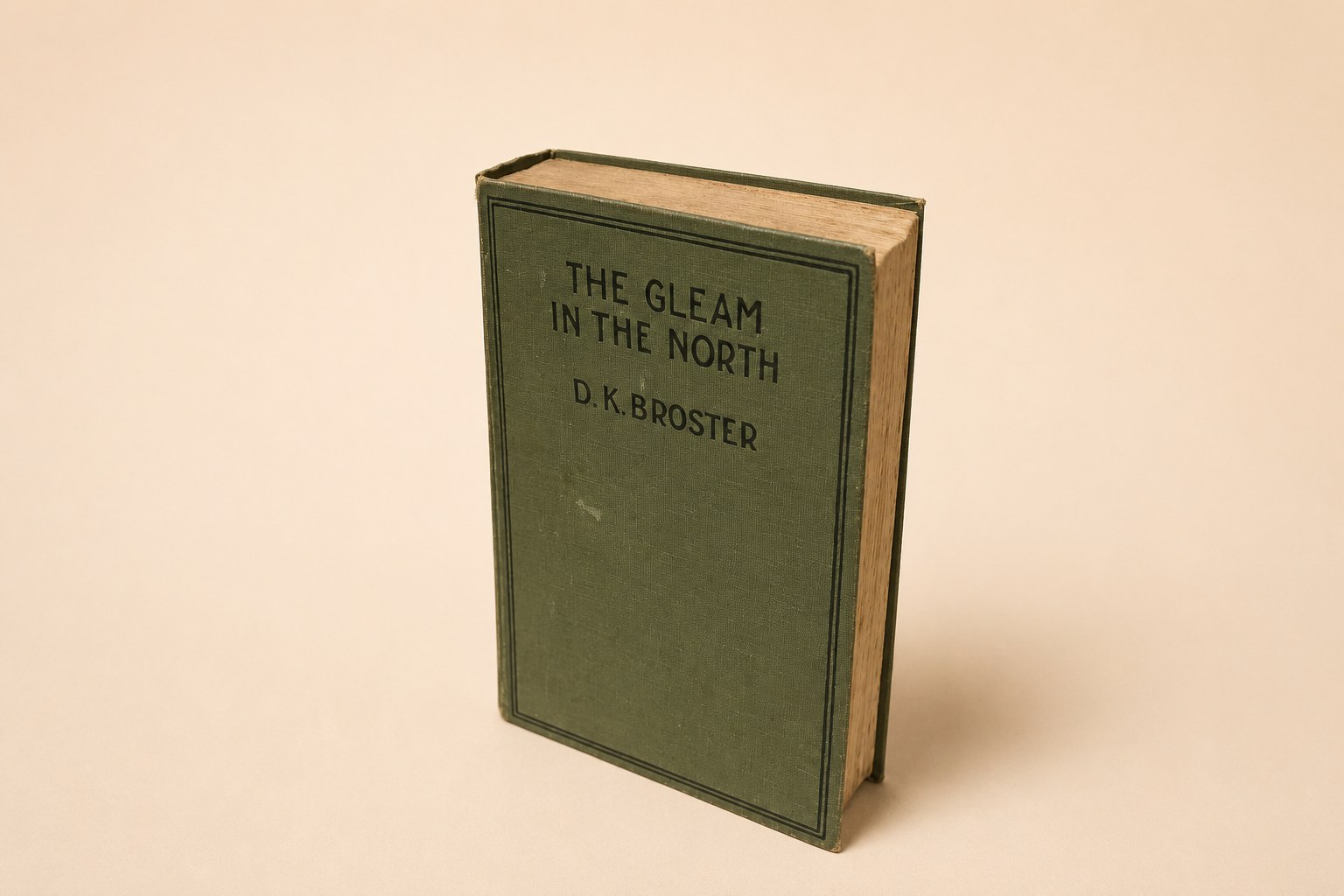
A novel that keeps a promise: its final scenes use the actual last words of Dr Archibald Cameron, the last Jacobite executed for treason. Heinemann, 1930 impression, the trilogy's fifth printing in three years.