Before photography, before the railway, before any but a handful of Europeans had stood on the deck of a ship bound for the Indian Ocean, a faraway place existed only as a claim — a thing other people swore to. The oldest object in this collection is exactly such a claim, beautifully engraved and almost entirely wrong.
Tomaso Porcacchi's Descrittione dell'Isola Taprobana, cut by Girolamo Porro and printed in Venice around 1590, is not a record of Ceylon. It is an argument about Ceylon, assembled from Ptolemy, Pliny, and the half-remembered reports of sailors by men who had never smelled the island's cinnamon or seen its coast. The geographical essay on the reverse does the same work in prose. For most of human history this is what it meant to look at a distant place: not to see it, but to believe in it, carefully.
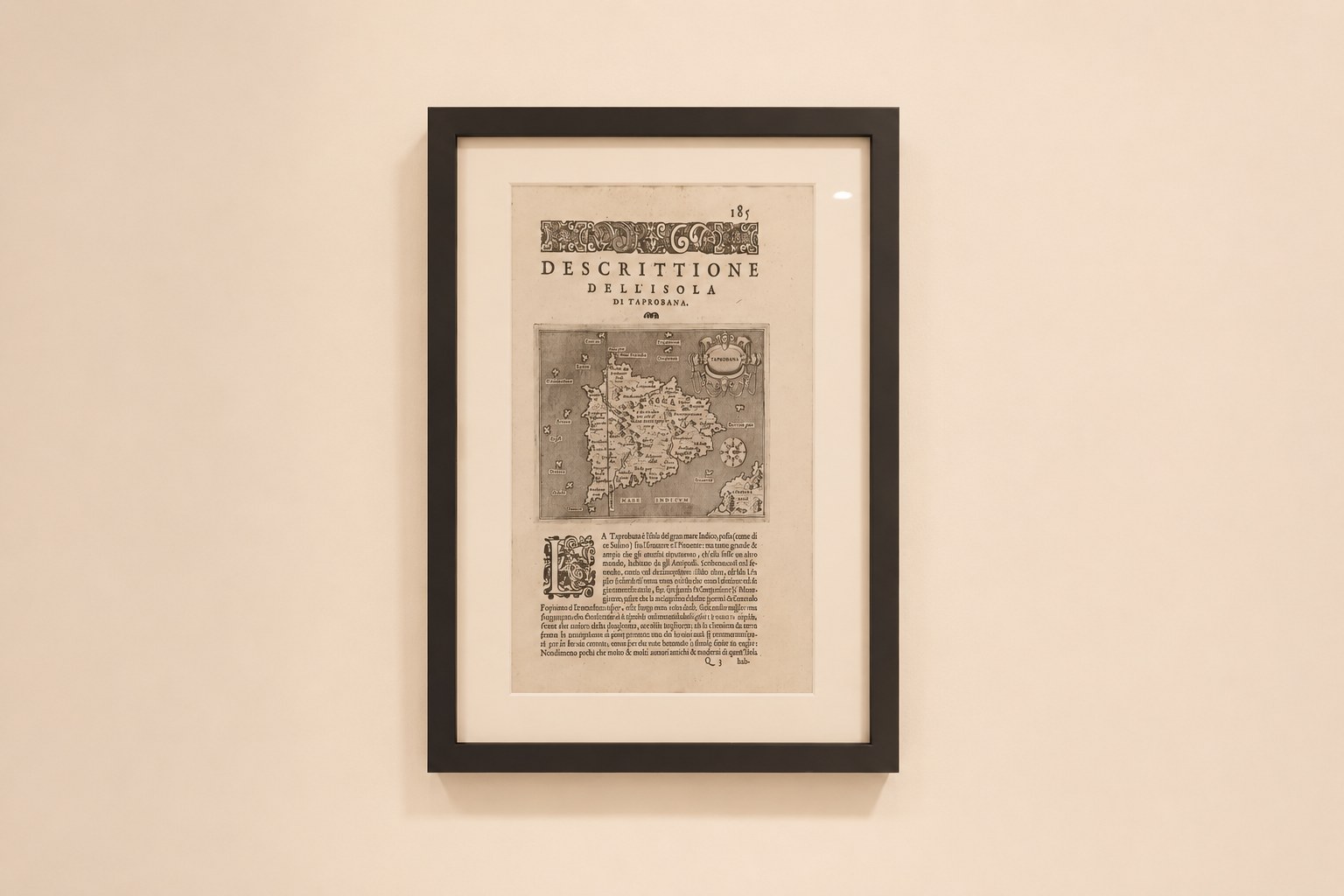
A Venetian copperplate map of an island Europe argued over for two thousand years: Taprobana, the dream-version of Sri Lanka, engraved by Girolamo Porro for Porcacchi's island atlas, c.1590.
View object →
Three hundred years later, the Album von Bremen shows what changed the rules. In 1891 Ernst Roepke of Wiesbaden sold visitors twelve albumen silver prints of the Rathaus, the Roland statue, the Börse, and the Marktplatz, mounted on card and folded like a concertina. Photography offered the one thing the engraver never could: proof. And the proof was industrial. The negatives are numbered 2284 to 2295 — these were stock images, struck off by the hundred and sold to anyone with coins in his pocket. A place had become a product, certified by chemistry and carried home in a coat.
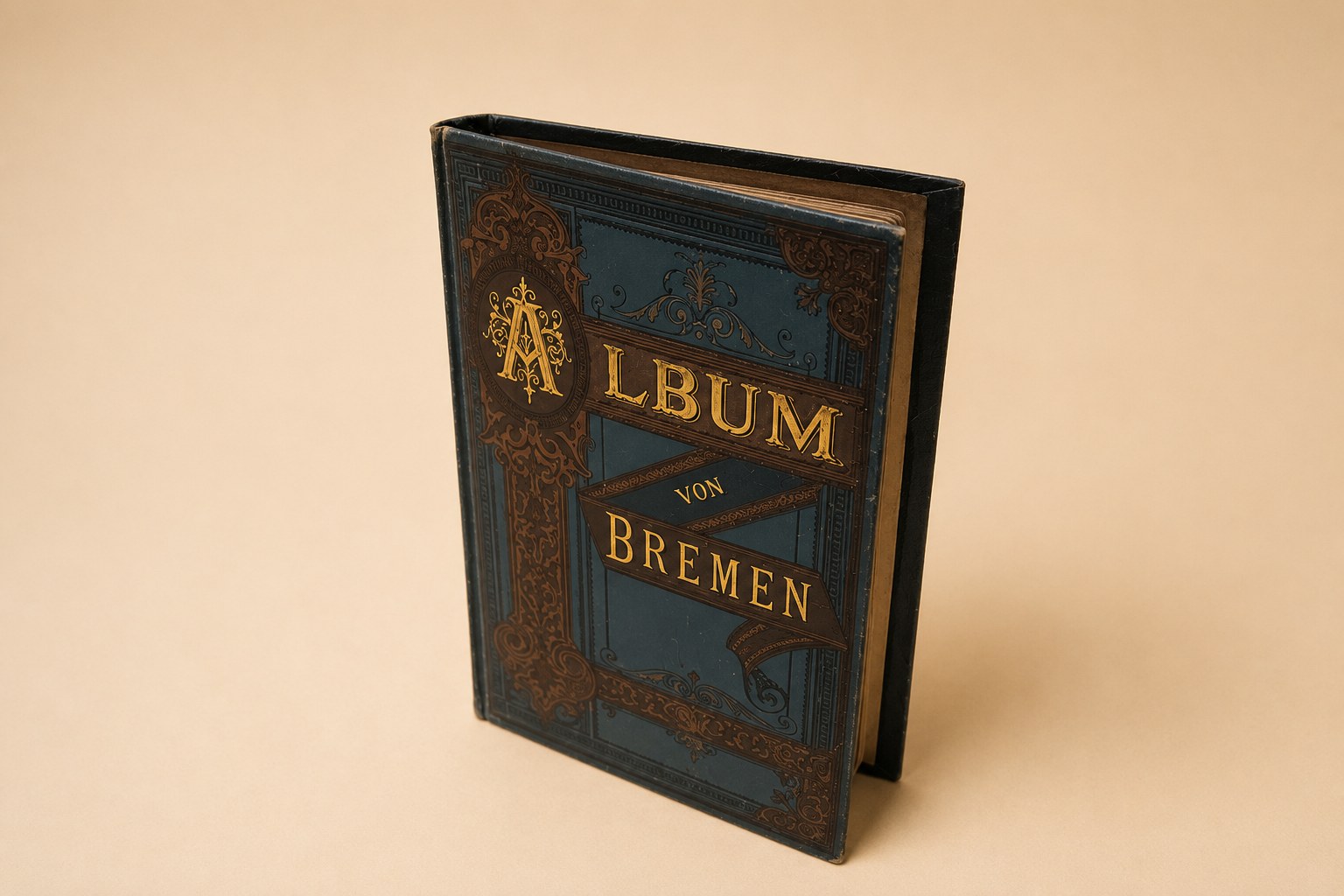
Twelve egg-white photographs of a city the bombs later erased: an 1891 concertina-fold souvenir of Hanseatic Bremen, including monuments that became UNESCO World Heritage 113 years after the shutter clicked.
View object →Conviction, then evidence, then memory — three ways of taking a place home.
Then the story does something strange. It bends back. Between 1948 and 1954, with photography long since universal and a camera in half the nation's hands, the artist Sydney R. Jones surveyed the whole of England in nothing but pen and ink: England South, England West, and England East. The Studio issued the three volumes while Britain dug itself out of the rubble, and the choice of the drawn line over the lens was deliberate to the point of defiance. A camera records everything in front of it, indifferently. Ink refuses to. Ink selects, simplifies, forgives, remembers. Jones was not proving England existed; he was recording how it felt, in the last moment before the motorways arrived to change it.
Forty years of sketch-books opened in the year England needed them most: the first volume of Sydney R. Jones's illustrated journey through the southern counties, from London to the very end of Cornwall (1948).
View object →
The trilogy's longest journey: Thames to Hadrian's Wall through Cotswold wool churches, Shakespeare country, the Marches, and the industrial North. The richest of the three volumes in architectural range (1950).
View object →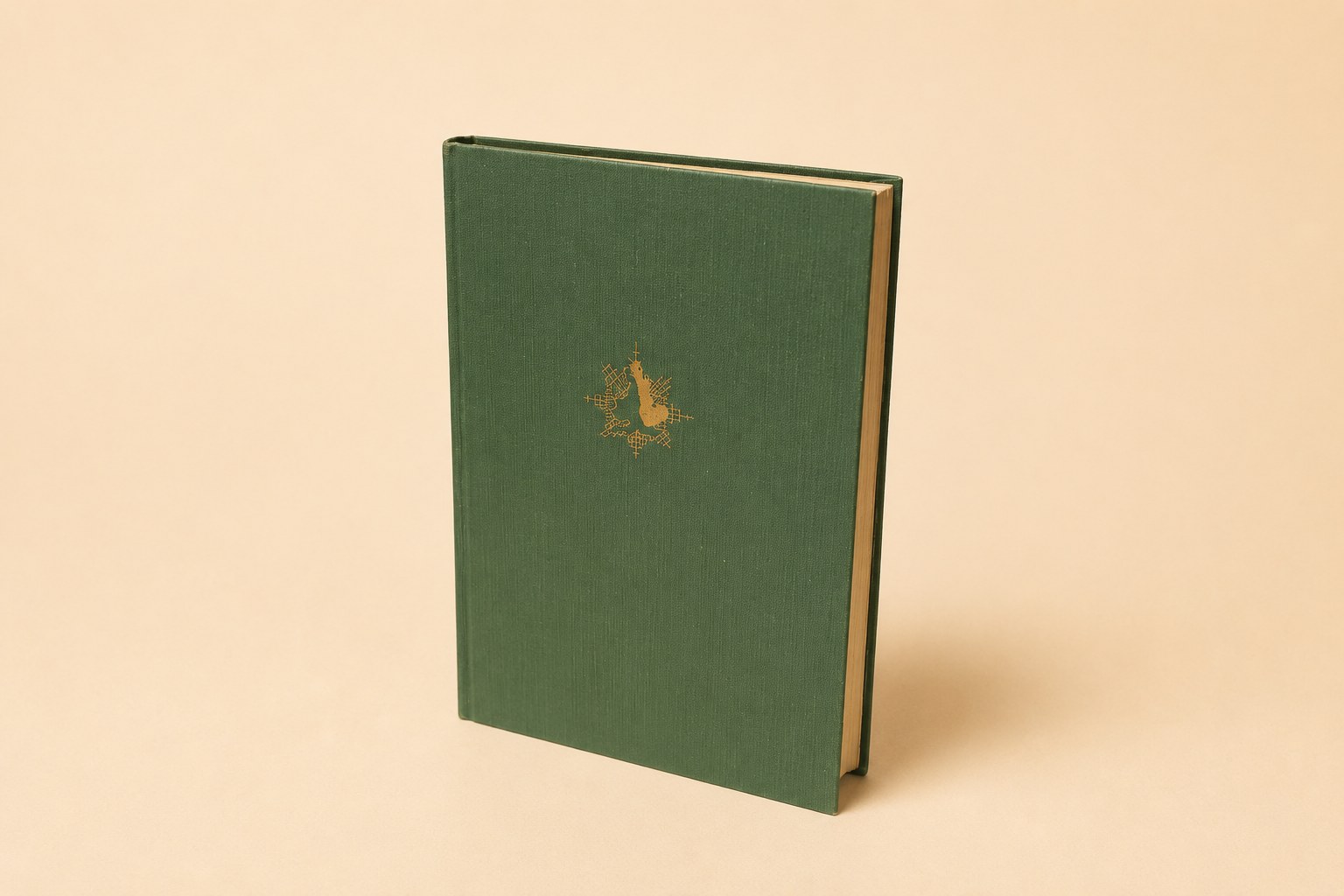
The farewell volume: Jones closes his life's work with a journey from the Thames to the Scottish border, saluting Durham coalminers alongside Northumbrian castles, under an epigraph about ashes and graves (1954).
View object →Set the three technologies side by side and they trace a complete arc in the human habit of bringing places back with us. First the engraved conjecture, made from rumour and authority. Then the photographic certificate, made from light and silver and sold to all comers. And finally the drawn elegy, made by a hand that had decided, county by county, what was worth keeping. Belief, then evidence, then memory.
It is no accident that the collection's two great threads — the island and the instruments — meet on this page. Every object here is itself an instrument: a device, whether copper plate or camera or steel nib, engineered to let a person see somewhere they will never stand. That is what a picture of a place has always been. The only thing that changes, century to century, is how much of the truth the instrument is willing to tell.