Books & Literature
Album von Bremen
Twelve egg-white photographs of a city the bombs later erased: an 1891 concertina-fold souvenir of Hanseatic Bremen, including monuments that became UNESCO World Heritage 113 years after the shutter clicked.
A Private Archive of Antiques & Historical Objects
Books & Literature
Twelve egg-white photographs of a city the bombs later erased: an 1891 concertina-fold souvenir of Hanseatic Bremen, including monuments that became UNESCO World Heritage 113 years after the shutter clicked.
Twelve photographs, printed on paper coated with egg white, of a city that no longer entirely exists. In 1891 Bremen was a proud Hanseatic city-state shipping emigrants to America by the thousand; in 1944 Allied bombing destroyed much of its historic centre. This little concertina of albumen prints, small enough for a coat pocket, preserves the city in between: the town hall, the Roland, the market square, photographed on glass plates 113 years before UNESCO declared two of its subjects World Heritage.
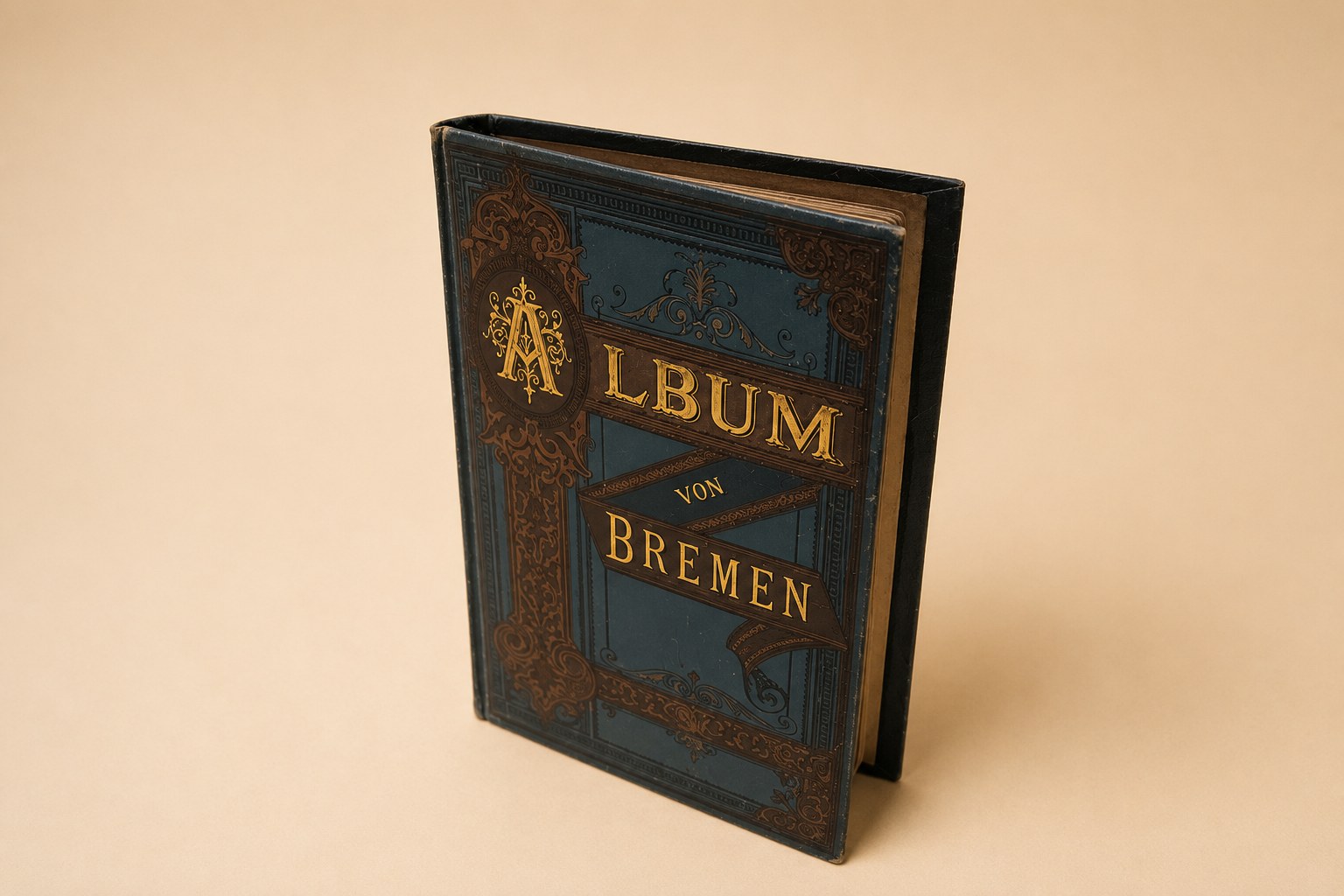
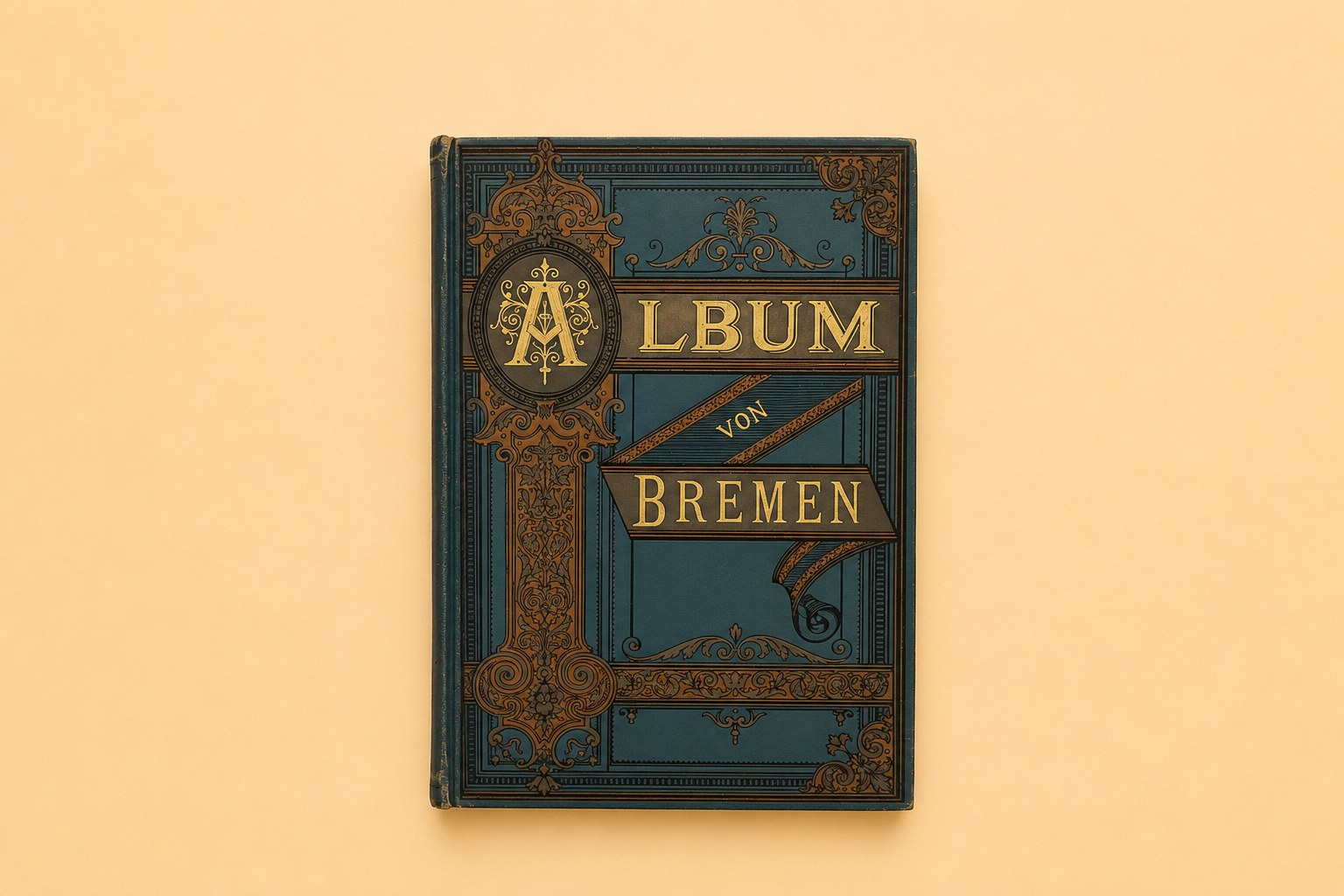
Album von Bremen is a souvenir photographic album in leporello format: accordion-folded card leaves opening into one continuous strip, named for the servant in Don Giovanni who unfolds the catalogue of his master's conquests. The green cloth cover is gilt-lettered; the final leaf carries the imprint Ernst Roepke. Wiesbaden 1891 with its Schutz-Marke notice, a registered trademark under Germany's pioneering 1874 trademark law.
Inside are twelve albumen silver prints, numbered 2284–2295: a panorama; the Rathaus; the Roland statue; the Börse; the Imperial Post Office; the Bleikeller (the cathedral's lead cellar, a public curiosity since the seventeenth century for its naturally mummified bodies); the Ratskeller, pouring wine continuously since 1405; the town hall's great hall; the Gewerbehaus; the Freihafen; the Wallanlage park ring laid over the demolished medieval ramparts; and the Marktplatz. Each print was contact-made from a glass negative onto paper sensitised with silver nitrate in egg white (a dozen prints required the whites of several dozen eggs) in the final years before gelatin papers swept the albumen era away.
Ernst Roepke of Wiesbaden ran a substantial commercial operation producing leporello albums of European cities and resorts in a consistent house style; the catalogue numbers in this album alone reach 2,295, implying a vast and almost entirely unresearched photographic archive of late-nineteenth-century Europe. The photographers who exposed the actual plates go unnamed, as was standard; the publisher held the rights, the camera operators held the ladder. Wiesbaden, one of the great Wilhelmine spa towns, gave Roepke his market: prosperous tourists wanting their travels miniaturised.
The Bremen of these plates was one of the three free Hanseatic cities of the new German Empire, self-governing, senate and all, its wealth riding on Atlantic trade and the Norddeutscher Lloyd shipping line, then among the largest passenger fleets in the world, carrying Germany's emigrants to New York. The 1404 Roland in print no. 2286 was the medieval symbol of the city's market rights and independence; together with the Rathaus it was inscribed as a UNESCO World Heritage Site in 2004. The album is therefore a nineteenth-century photograph of monuments now under international protection, and of streetscapes the 1944 bombing erased.
This copy is in good condition: the accordion folds intact, the green cloth and gilt lettering sound, all twelve prints present with their captions and catalogue numbers legible. Albumen prints are chemically delicate, prone to fading and yellowing, and a complete, well-toned set is the exception rather than the rule at this age.
This is the collection's only photographic object, and it earns the spot on three counts. It is a primary visual record of a European city at a moment now unrecoverable. It is a textbook specimen of the albumen era at its commercial peak, a few years before the medium vanished. And it is a fragment of a forgotten industry: Roepke's thousands of numbered views amount to a street-level portrait of Europe that no government or artist of the period ever attempted, sold one pocket-sized concertina at a time.
Provenance
No ownership marks; prior owners unknown. Self-dating imprint 'Ernst Roepke. Wiesbaden 1891' with Schutz-Marke notice; prints carry publisher's catalogue numbers 2284–2295.
England South
Forty years of sketch-books opened in the year England needed them most: the first volume of Sydney R. Jones's illustrated journey through the southern counties, from London to the very end of Cornwall (1948).
England West
The trilogy's longest journey: Thames to Hadrian's Wall through Cotswold wool churches, Shakespeare country, the Marches, and the industrial North. The richest of the three volumes in architectural range (1950).
England East
The farewell volume: Jones closes his life's work with a journey from the Thames to the Scottish border, saluting Durham coalminers alongside Northumbrian castles, under an epigraph about ashes and graves (1954).