Books & Literature
The View from Serendip
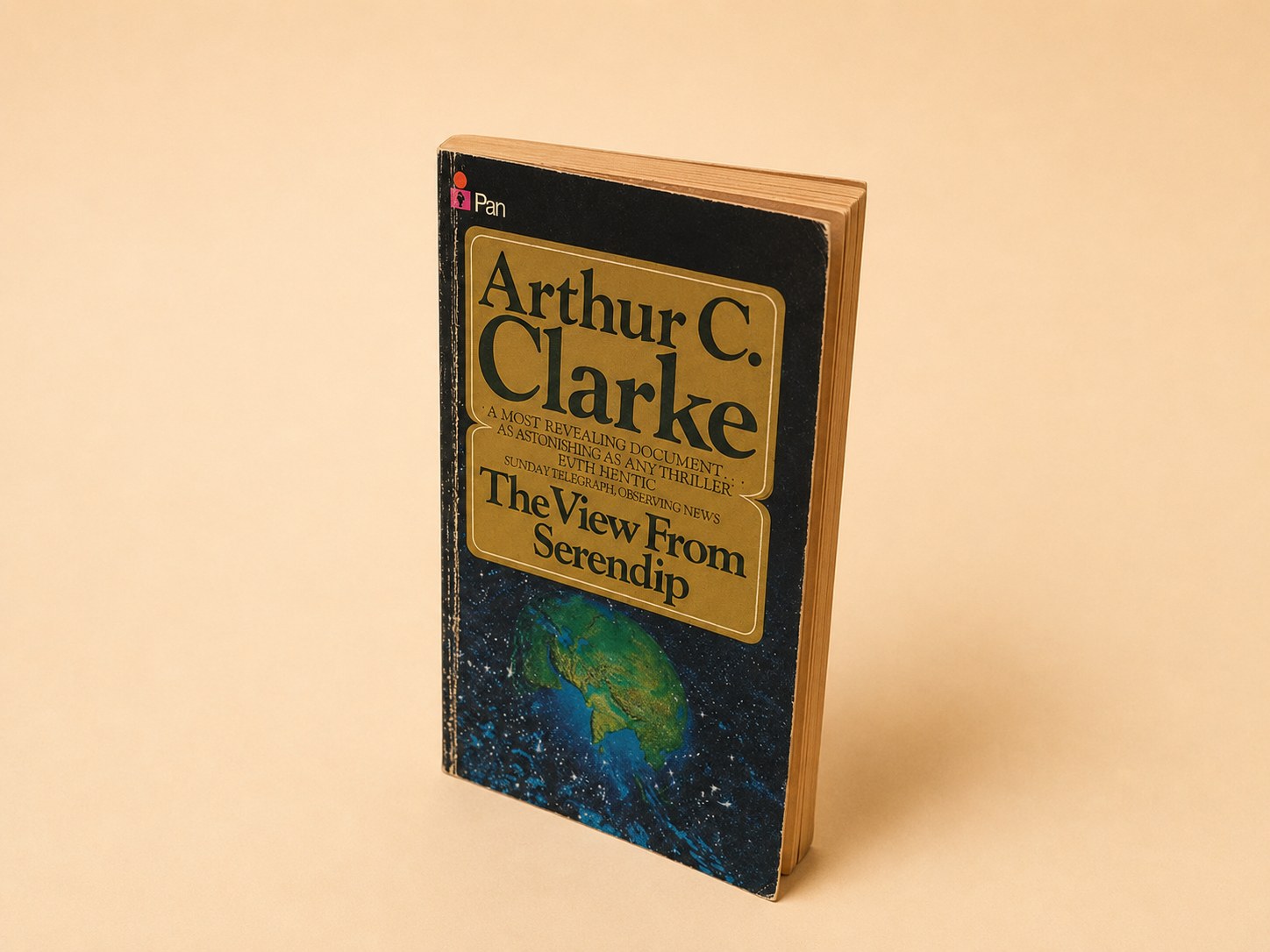
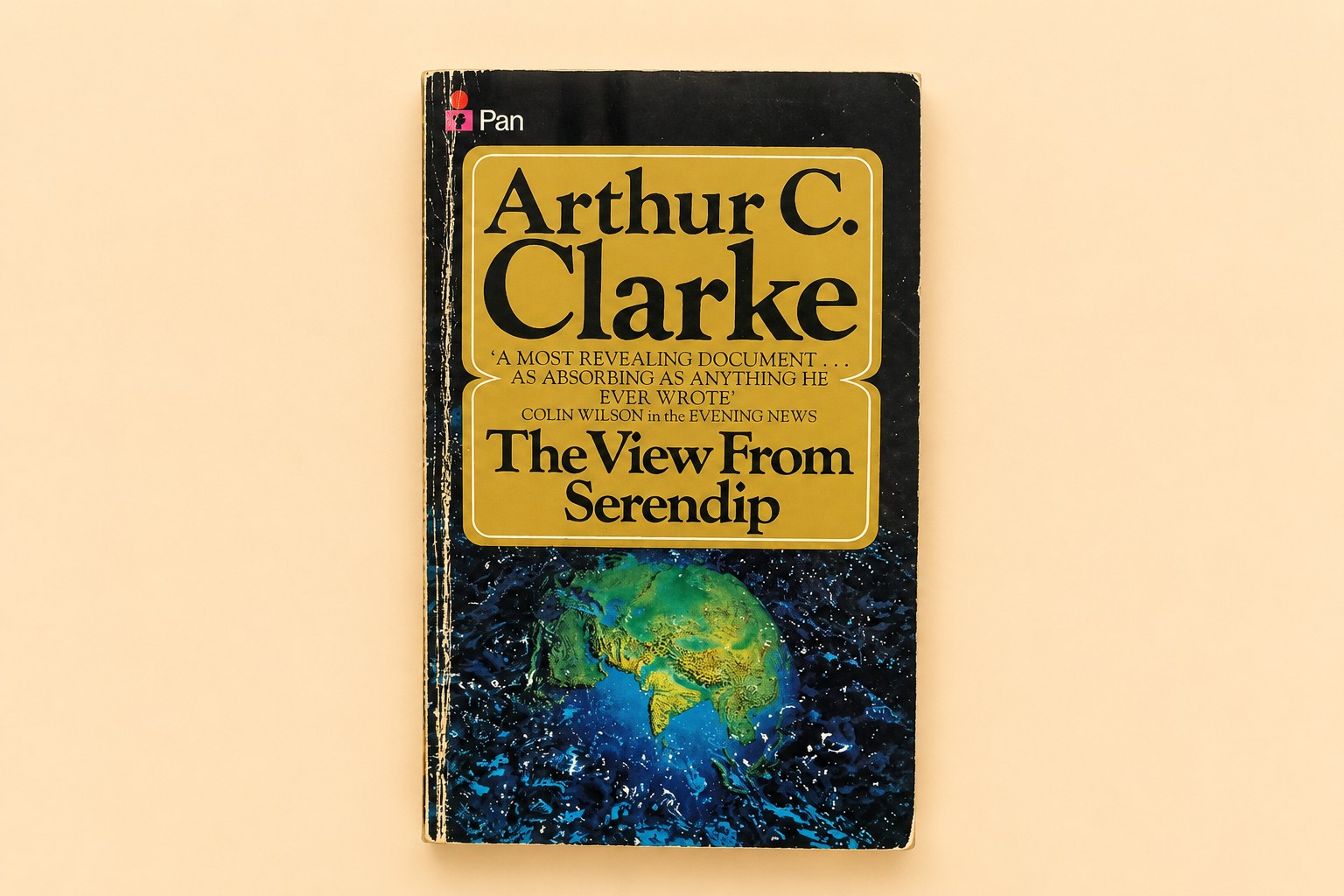
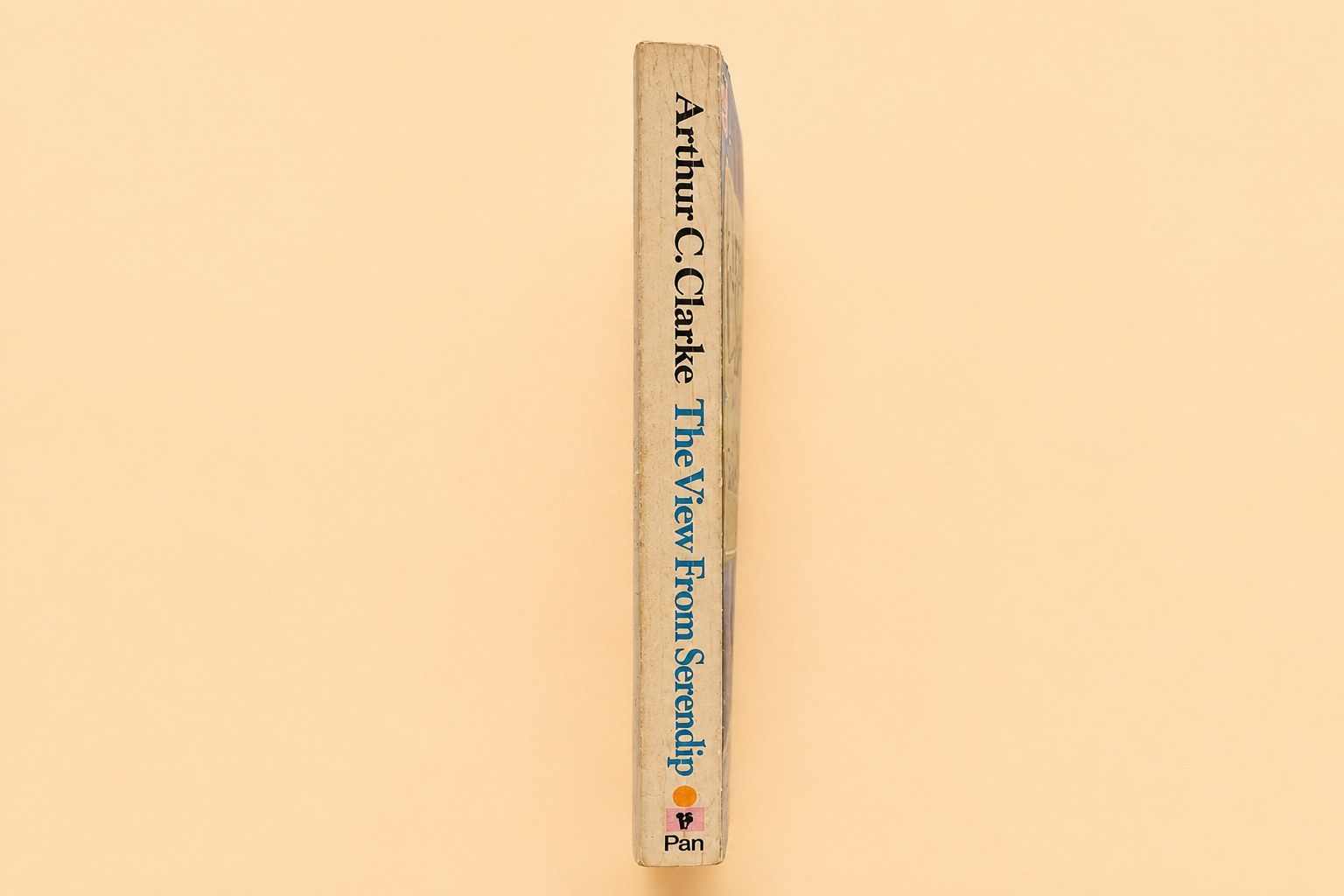
Clarke's Sri Lankan essays in the 1979 Pan paperback, inscribed by him at Colombo in 1980 to a 'Professor Shoenberg' — most likely the Cambridge physicist David Shoenberg.
A Private Archive of Antiques & Historical Objects
Books & Literature
Clarke's Sri Lankan essays in the 1979 Pan paperback, inscribed by him at Colombo in 1980 to a 'Professor Shoenberg' — most likely the Cambridge physicist David Shoenberg.
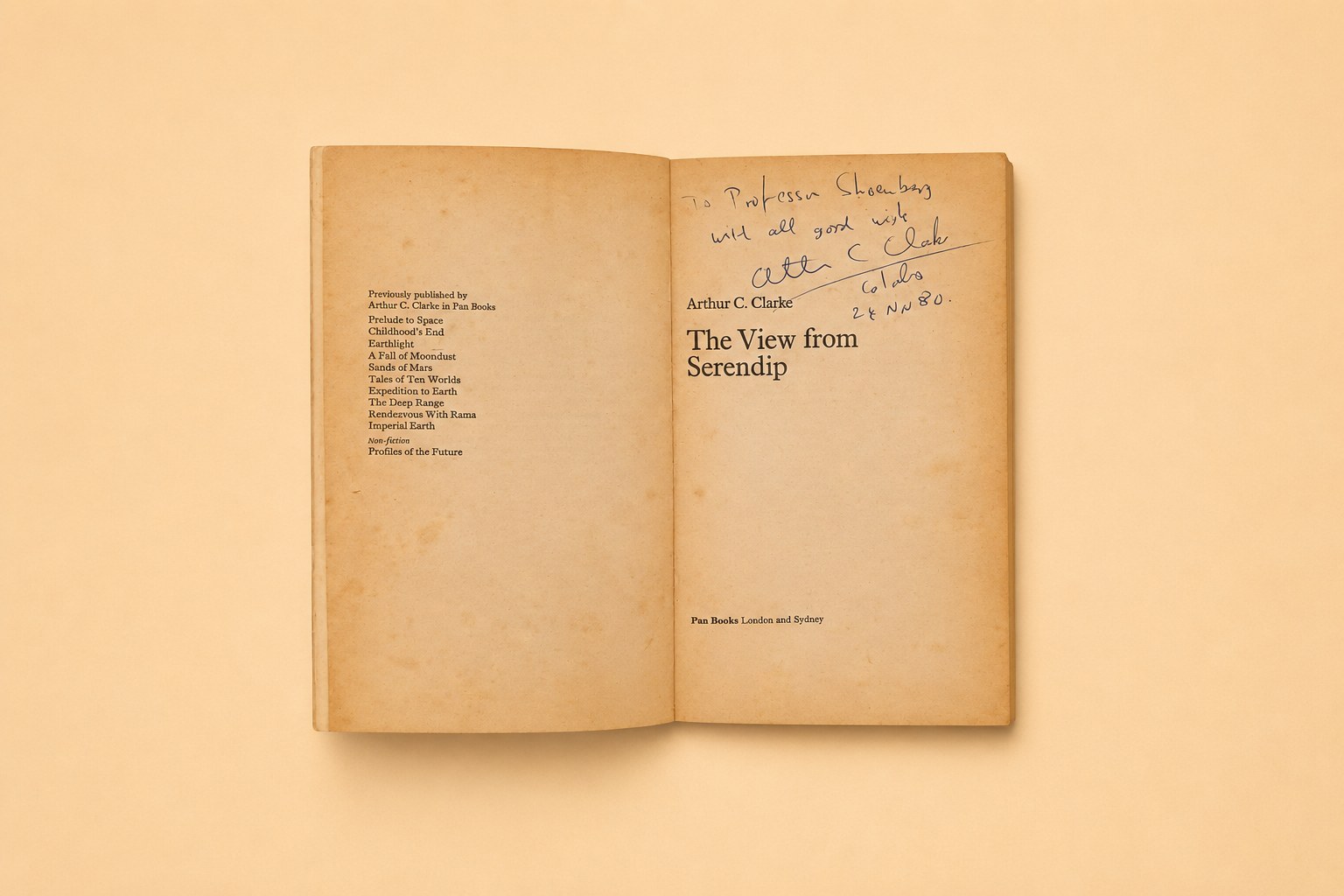
This is, on the face of it, the cheapest object in the collection: a 1979 mass-market paperback that sold for 95 pence, its pages already browning the way all wood-pulp paperbacks of the period do. Turn to the title page and the value inverts. There, in ink, Arthur C. Clarke has written To Professor Sho[e]nberg, with all good wishes, Arthur C. Clarke, Colombo, and dated it 1980. A throwaway paperback becomes an association copy: the author's own memoir of his adopted island, signed by him on that island, and given to a man whose identity is the small mystery this entry sets out to solve.
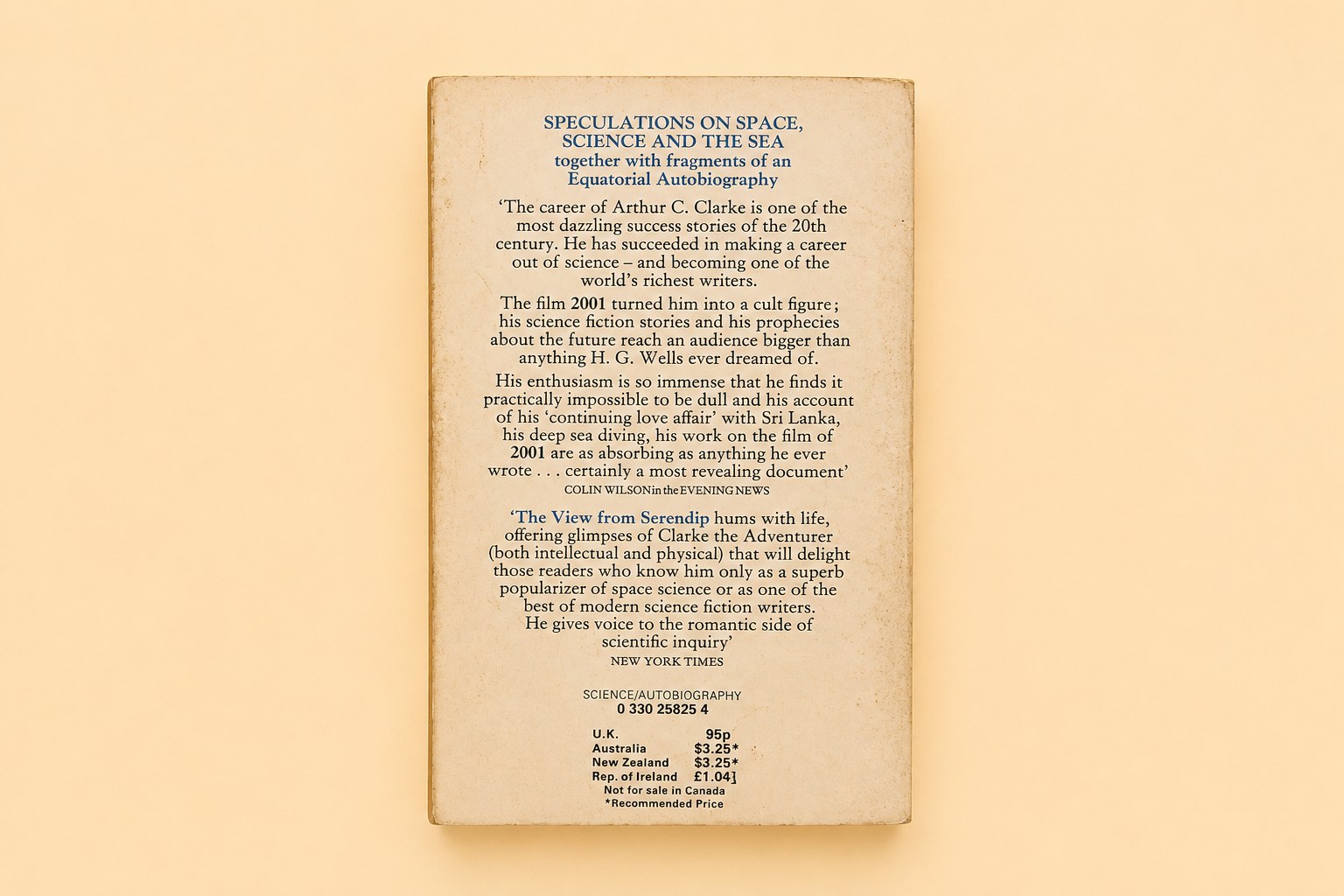
The View from Serendip is a collection of Clarke's essays, lectures and autobiographical fragments, first published in 1977 and described on its own cover as speculations on space, science and the sea, together with fragments of an equatorial autobiography. This copy is the Pan Books paperback of 1979 (ISBN 0 330 25625 4, 236 pp.), printed in London and Sydney, its back cover still carrying the period price grid — 95p in the UK, $3.25 in Australia. The contents range across the future of space, deep-sea diving, the making of the film 2001, fellow science-fiction writers such as Isaac Asimov, after-dinner speeches, and — the thread that names the book — his life in Ceylon.
The title is a small history lesson. Serendip is the old Persian and Arabic name for Ceylon (Serendib), and it is the root of serendipity, a word coined by Horace Walpole in 1754 after the fairy tale The Three Princes of Serendip, whose heroes were forever making fortunate discoveries by accident. For Clarke, who had moved to Ceylon in 1956 and never left, the pun was the point: the island was both his home and his happy accident.
Sir Arthur C. Clarke (1917–2008) is among the most influential figures of twentieth-century science and science fiction: author of 2001: A Space Odyssey and Rendezvous with Rama, and the man who, in a 1945 paper in Wireless World, first set out the idea of geostationary communications satellites — the orbit now formally called the Clarke Orbit. From 1956 he lived in Colombo, diving, writing, and broadcasting, until he became so identified with the country that Sri Lanka eventually made him a special honour. A book of his Ceylon essays, signed by him in Colombo, is therefore Clarke at his most characteristic — and squarely on the Island thread of this collection.
The dedication reads, as nearly as the hand allows: “To Professor Sho[e]nberg / with all good wishes / Arthur C. Clarke / Colombo / 24 · 80.” Two things make it convincing. First, the wording and layout — with all good wishes, Arthur C. Clarke, Colombo, and a date — are exactly the formula Clarke used when inscribing books for visitors and admirers, of which many documented examples survive. Second, the place: Colombo was his home, so a book inscribed there in 1980 is precisely where and when one would expect a Clarke presentation copy to originate.
The open question is the recipient. Who was the Professor Shoenberg who carried a British paperback of Clarke's essays to Colombo — or met Clarke there — and came away with it signed?
The strongest candidate, offered here as an inference and not an established fact, is Professor David Shoenberg, FRS (1911–2004), the Cambridge physicist. The fit is good on several counts. He was a genuine and prominent Professor Shoenberg of exactly this period — Professor of Physics at Cambridge from 1973 and Emeritus from 1978, so “Professor Shoenberg” in 1980 describes him precisely. He was British and Cambridge-based, consistent with a UK-published Pan paperback that travelled out to Ceylon in its owner's luggage. And he was a figure of real distinction: a pioneer of British low-temperature physics, trained under Pyotr Kapitza in the Mond Laboratory, elected FRS in 1953, and later awarded the Royal Society's Hughes Medal (1995) for his work on the de Haas–van Alphen effect.
There is also a resonance almost too neat to ignore. David Shoenberg was the son of Sir Isaac Shoenberg, the EMI engineer who led the team behind the world's first regular high-definition television service in 1936. If the identification is right, then a book by the man who invented the communications satellite — the device that would beam television across the planet — was inscribed to the son of the man who gave Britain television in the first place. The two ends of the broadcasting century, meeting on one title page.
Three further points, established in the July 2026 research pass, strengthen the case. The spelling is nearly a fingerprint: Shoenberg without a 'c' is, in British public life, essentially unique to Sir Isaac Shoenberg's family — the Royal Television Society's annual lecture is the Shoenberg Memorial Lecture — and a search for any other "Professor Shoenberg" of that spelling active around 1980 has produced none. The timing fits: Shoenberg retired from the Cavendish chair in September 1978, so in 1980 he was newly emeritus — the classic window for long-haul travel — while still fully active as a scientist (his monograph Magnetic Oscillations in Metals, 1984, was then in preparation). And the geography of this copy's reappearance points to Cambridge: the parcel was posted from Clavering Post Office (CB11 4PE), a village in the Cambridge postcode area some twenty-two miles from the city where Shoenberg lived until his death in 2004 — consistent with a Cambridge-region dispersal of his library (Royal Mail tracking, June 2026, retained in the dossier).
Honesty requires the counterweight. No documented connection between David Shoenberg and Arthur C. Clarke has been found, and there is no record placing Shoenberg in Colombo in 1980; “Professor Shoenberg” is not a unique identifier, and the recipient could in principle be another academic of the name. The identification rests on plausibility — the right title, the right era, the right nationality, and now the right geography — not yet on proof. The collection therefore records it as a hypothesis, and the item's Verification status as Research Ongoing.
The route to proof is now specific. Clarke's papers are held by the Smithsonian's National Air and Space Museum as the Arthur C. Clarke Collection of Sri Lanka (NASM.2015.0010), fully processed and open for research; Series 1 preserves his correspondence in chronological folders, and the 1980 run survives (Boxes 24–25: January–June and October–December 1980). A visitor who carried away an inscribed book may well have written ahead, or written to say thank you — a reading-room inquiry for "Shoenberg" in those folders is the single most promising step. On the Shoenberg side, the standing sources are an oral-history interview recorded by the American Institute of Physics on 10 February 1981 — four months or so after the inscription; transcript and audio via the Niels Bohr Library & Archives (nbl@aip.org) — the National Archives' name record for his papers, and Brian Pippard's Royal Society memoir.
The book is in good condition for an inexpensive paperback of its age: covers sound, binding firm, the text-block uniformly toned as the cheap paper of the period always becomes. Its interest is entirely the association — the in-Colombo authorial inscription — rather than the printing, which is a common one. The leaf bearing the dedication is clean and the writing legible apart from the abbreviated day-and-month of the date; the year, examined in hand, is securely 1980.
The object earns its place three times over. It is a Clarke association copy, signed by him in Colombo, of his own book about the island — a near-perfect fit for the collection's Sri Lanka thread. It carries a live research problem of exactly the kind the Charter prizes: identify the unnamed, a named but unconfirmed recipient who can be pursued toward verification. And, if the Shoenberg identification can ever be nailed down, it becomes something rarer still: a single page on which the inventor of the comsat and the family that built British television briefly, accidentally, came together — a genuinely serendipitous view from Serendip.
Provenance
Author's presentation inscription to the title page, in ink: 'To Professor Sho[e]nberg / with all good wishes / Arthur C. Clarke / Colombo / 24 · 80' — i.e. signed by Clarke at his home in Colombo in 1980 (day/month abbreviation hard to read; year 1980 confirmed by physical examination). Inscription format matches Clarke's documented signing style. Recipient NOT yet confirmed; leading candidate (inference, not established fact): Professor David Shoenberg FRS (1911–2004), Cambridge physicist. Supporting evidence (July 2026 research pass): (1) the 'Shoenberg'-without-c spelling is essentially unique in British public life to the Isaac Shoenberg family; no other 'Professor Shoenberg' of that spelling active c. 1980 traced; (2) newly emeritus from the Cavendish chair (retired Sept 1978), free to travel in 1980; (3) parcel provenance — acquired 2026 from an Amnesty International charity listing on eBay, posted from Clavering Post Office CB11 4PE (Cambridge postcode area, ~22 miles from Cambridge, where Shoenberg lived until 2004); Royal Mail tracking retained (despatched 11 June 2026, accepted 13 June 2026). NEXT STEPS: (a) reading-room inquiry at Smithsonian NASM, Arthur C. Clarke Collection of Sri Lanka NASM.2015.0010, Series 1 correspondence, Boxes 24–25 (Jan–Jun & Oct–Dec 1980) for 'Shoenberg'; (b) AIP Niels Bohr Library oral history of 10 Feb 1981 (nbl@aip.org); (c) Pippard's Royal Society memoir & TNA name record F41666 for his papers. Verification status: Research Ongoing.
England South
Forty years of sketch-books opened in the year England needed them most: the first volume of Sydney R. Jones's illustrated journey through the southern counties, from London to the very end of Cornwall (1948).
England West
The trilogy's longest journey: Thames to Hadrian's Wall through Cotswold wool churches, Shakespeare country, the Marches, and the industrial North. The richest of the three volumes in architectural range (1950).
England East
The farewell volume: Jones closes his life's work with a journey from the Thames to the Scottish border, saluting Durham coalminers alongside Northumbrian castles, under an epigraph about ashes and graves (1954).