Optics & Photography
Sacred Bo Tree, Anuradhapura
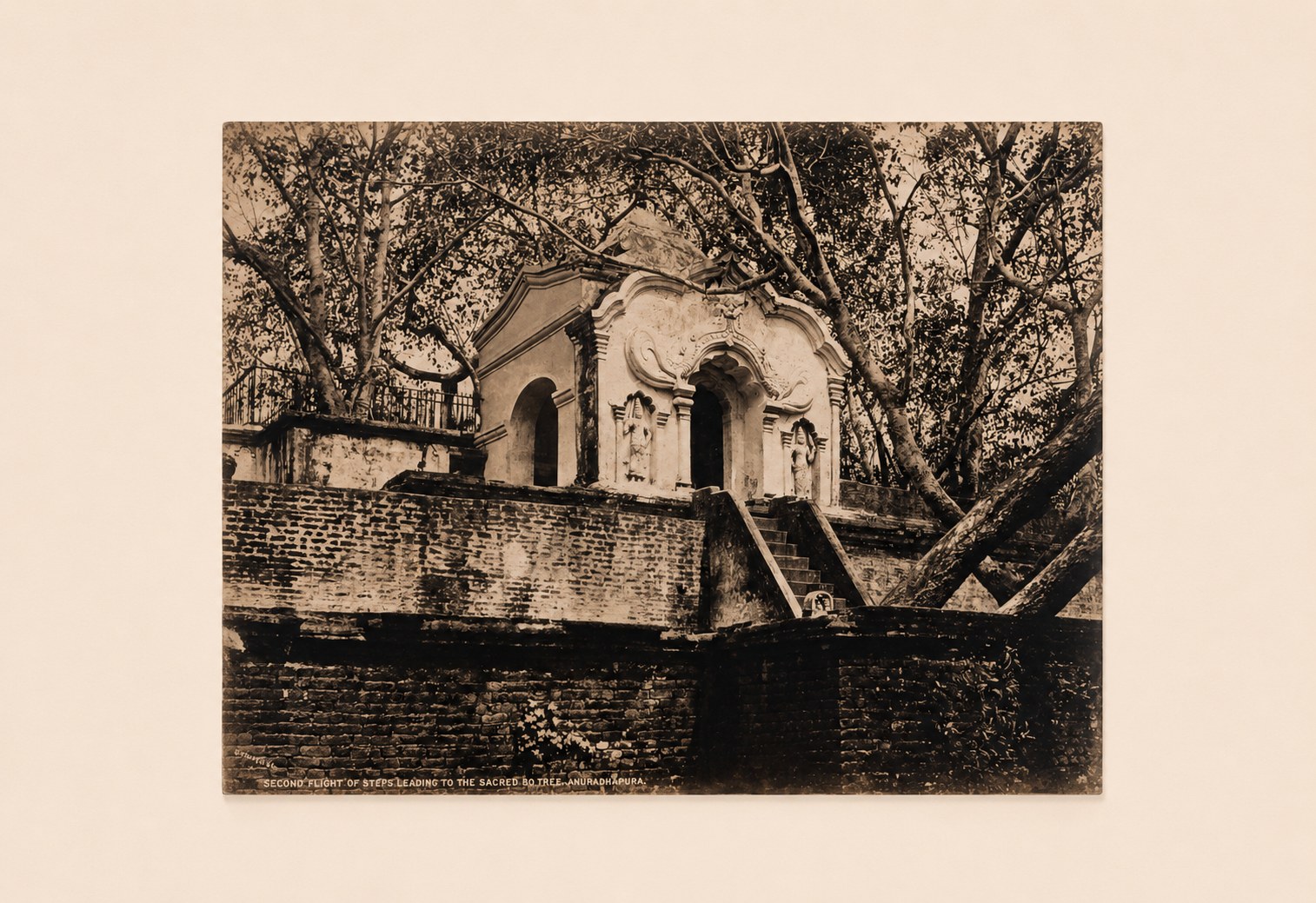
A Scowen & Co. albumen view of the terraced steps to the Sacred Bo Tree at Anuradhapura — the oldest human-planted tree on earth with a recorded planting date.
A Private Archive of Antiques & Historical Objects
Optics & Photography
A Scowen & Co. albumen view of the terraced steps to the Sacred Bo Tree at Anuradhapura — the oldest human-planted tree on earth with a recorded planting date.
A worn flight of stone steps, a small ornate shrine half-swallowed by roots and shadow, and somewhere behind it the most venerated tree in the Buddhist world. This is the terraced approach to the Sacred Bo Tree at Anuradhapura, photographed by Scowen & Co. of Ceylon in the closing decades of the nineteenth century — a contact print on egg-white paper of a place pilgrims have been climbing for more than two thousand years. The dealer offered it as an anonymous "[Buddhist temple, Ceylon]." The caption printed into the negative says otherwise.
This is a single albumen silver print, the dominant photographic print of the Victorian age: a glass-plate negative contact-printed onto paper sensitised with silver salts suspended in egg white, which gives the image its warm sepia depth and faint surface sheen. Along the lower edge, printed into the negative rather than inked on afterwards, runs the title SECOND FLIGHT OF STEPS LEADING TO THE SACRED BO TREE, ANURADHAPURA beside the studio credit Scowen & Co. That habit of titling and signing in the negative is the firm's signature, and it is what lets this otherwise loose print identify itself. The card mount carries a pencilled album number, 125, and a stock number — the fingerprints of a print that once lived in a bound Victorian album before being broken out for sale.
Charles Thomas Scowen (1852–1948) reached Ceylon in the early 1870s, opened the studio Scowen & Co. in Kandy by 1876, and added a Colombo branch in the following decade. The firm's output — landscapes, studies of people at work, the island's plant life, and archaeological views like this one — is generally judged the most accomplished of any commercial studio working in nineteenth-century Ceylon, prized for its lighting and composition. When Scowen wound the business down in the mid-1890s, the Colombo Apothecaries Co. bought his entire stock of negatives and went on printing from them, so impressions of his images circulated well after he himself had left photography to plant tea and, eventually, retire to Suffolk. His prints are now held by the J. Paul Getty Museum, the Metropolitan Museum, the Museum of Fine Arts Boston, Yale, the Art Institute of Chicago and the Royal Commonwealth Society collection at Cambridge.
The tree at the top of these steps is the Jaya Sri Maha Bodhi, and its pedigree is extraordinary. According to the chronicles it grew from a southern branch of the fig at Bodh Gaya under which the Buddha attained enlightenment, carried to the island by the nun Sanghamitta, daughter of the Indian emperor Ashoka, and presented to King Devanampiya Tissa, who planted it in his royal park in 288 BC. That makes it the oldest living human-planted tree on earth with a recorded planting date — a single organism with an unbroken, documented history older than almost any building.
The cutting was set on a raised terrace some 6.5 metres above the ground, and over the centuries successive kings and devotees wrapped the tree in ascending terraces, walls, railings and small shrines. The ornate structure in Scowen's photograph — with its arched makara gateway and flanking guardstone figures — is one of these later shrine-gateways on the climb. Scowen's near-contemporary, the archaeological photographer Joseph Lawton, catalogued an almost identical vantage as "the gateway on the west side, and second flight of steps leading from first to second terrace" (a comparison print survives in the Victoria and Albert Museum), which both confirms Scowen's title and places the camera precisely. The whole sacred city around it, Anuradhapura, is today a UNESCO World Heritage Site.
The print is in good condition for its age: even sepia tone, the image crisp, and — crucially — the in-negative title and Scowen & Co. credit clearly legible, along with the pencilled 125 on the mount. Albumen prints fade and yellow easily, so a clean, well-read impression with its identifying caption intact is the exception rather than the rule. It arrived as one of a pair with the collection's Thuparama Dagoba view, the two having travelled together out of the same broken album.
This sits squarely on the Island thread of the collection: early, named, technically superior photography of Ceylon by the studio the Charter lists as a standing acquisition target. It is also a small case study in the collection's own doctrine — identify the unnamed, date the undated, correct the catalogue. A dealer's vague "[Buddhist temple, Ceylon]" became, by simply reading the negative, a securely titled Scowen & Co. view of the oldest documented tree in the world, on a site under international protection. The image proves itself.
Provenance
Title and 'Scowen & Co.' credit printed in the negative (lower left), with a stock/negative number on the mount and a pencilled album number '125' — a print once mounted in a dispersed Victorian album. Catalogued generically by the dealer as '[Buddhist temple, Ceylon]'; identified here as the Sacred Bo Tree at Anuradhapura by reading the in-negative caption. Acquired from Shapero Rare Books, London, June 2026 (one of a pair; see companion Thuparama view).
Ensign Ful-Vue Super Camera
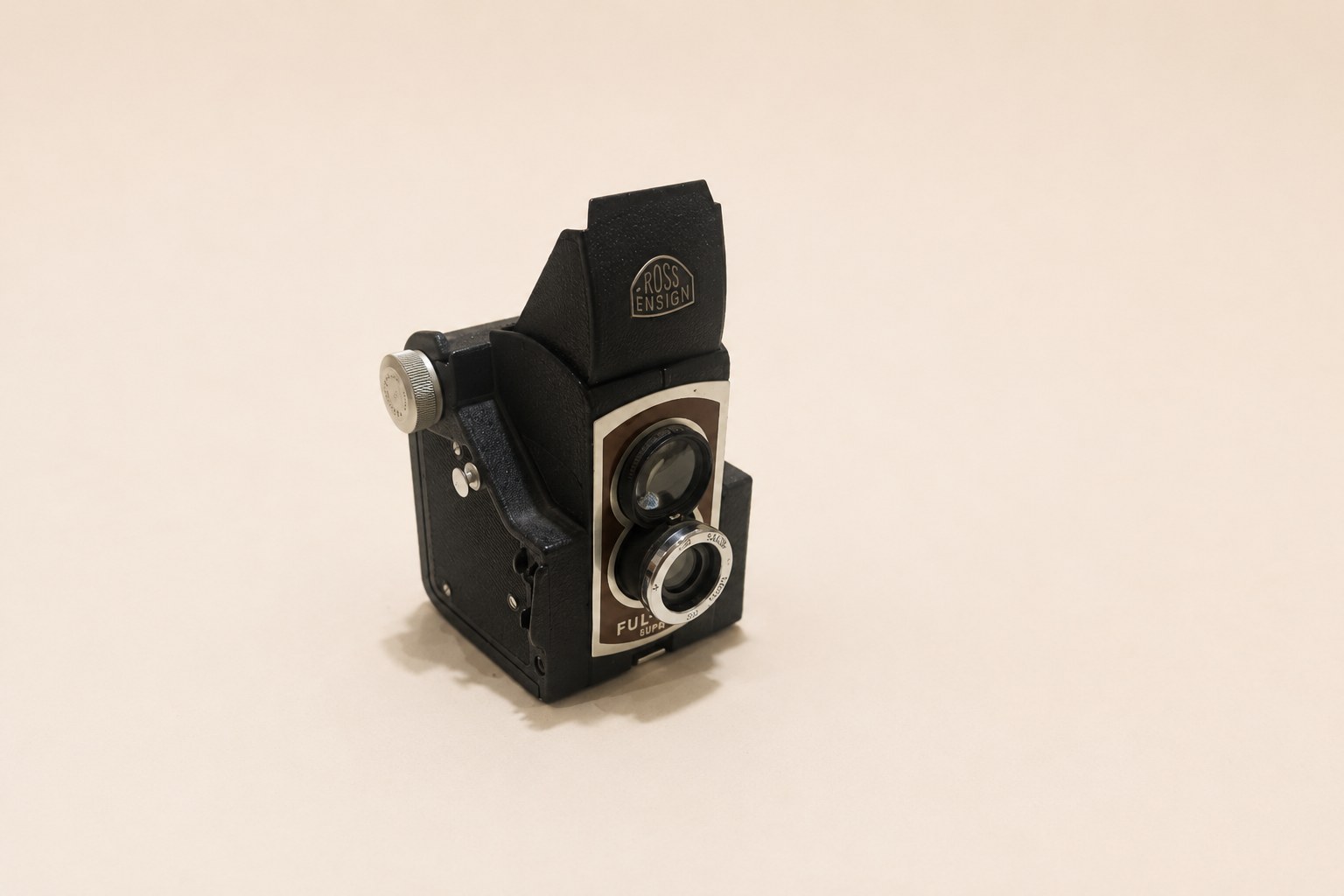
The camera that taught Britain to look down, not through: a 1954 Ross Ensign pseudo-TLR with a glowing waist-level finder, one shutter speed, and a lineage reaching back to Daguerre's London licence of 1839.
Thuparama Dagoba & Dalada Maligawa, Anuradhapura
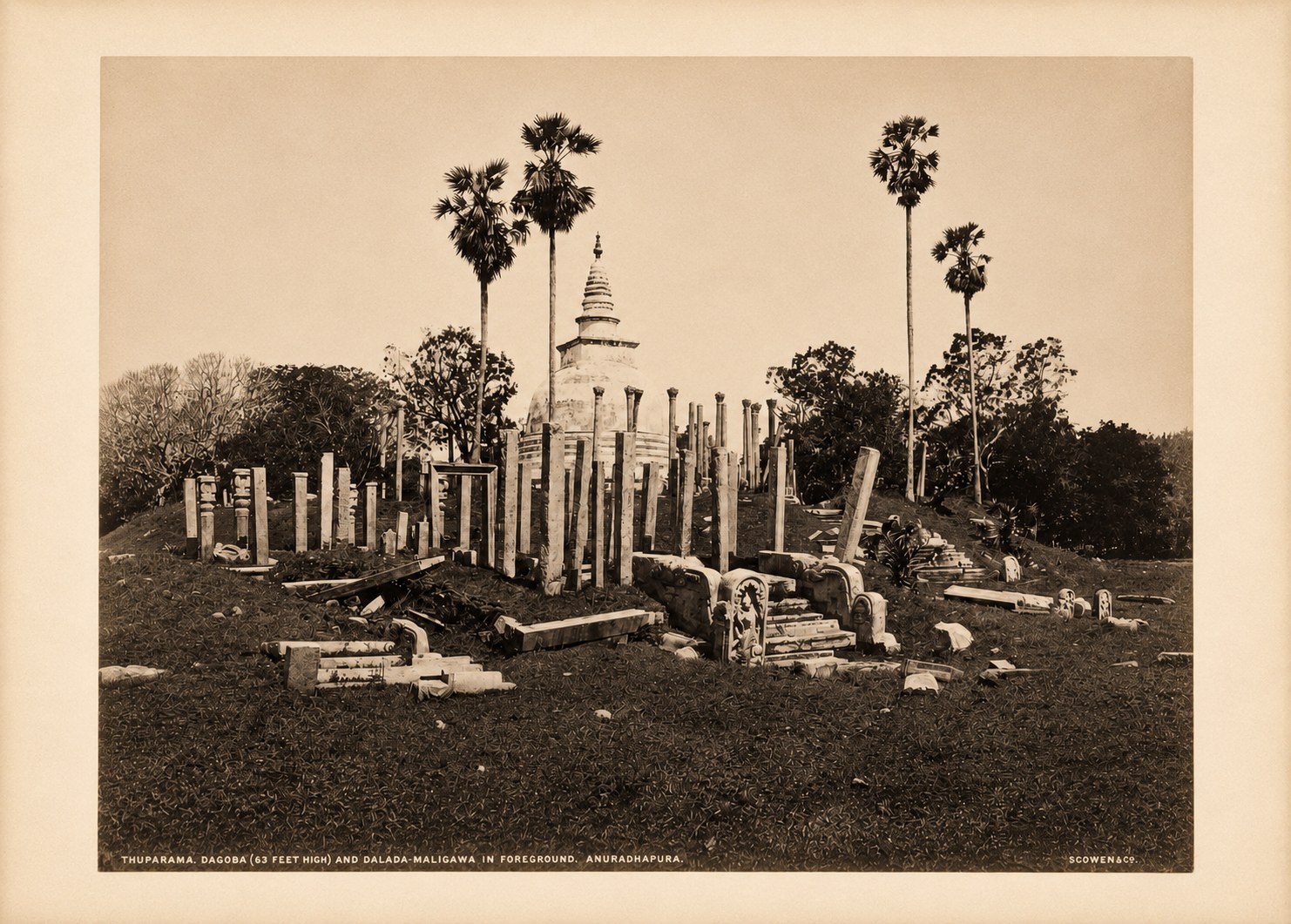
Scowen & Co.'s albumen view of Thuparama — the first stupa built in Sri Lanka — ringed by the leaning pillars of its ancient relic-house and a lost Temple of the Tooth.
Agfa Synchro-Box
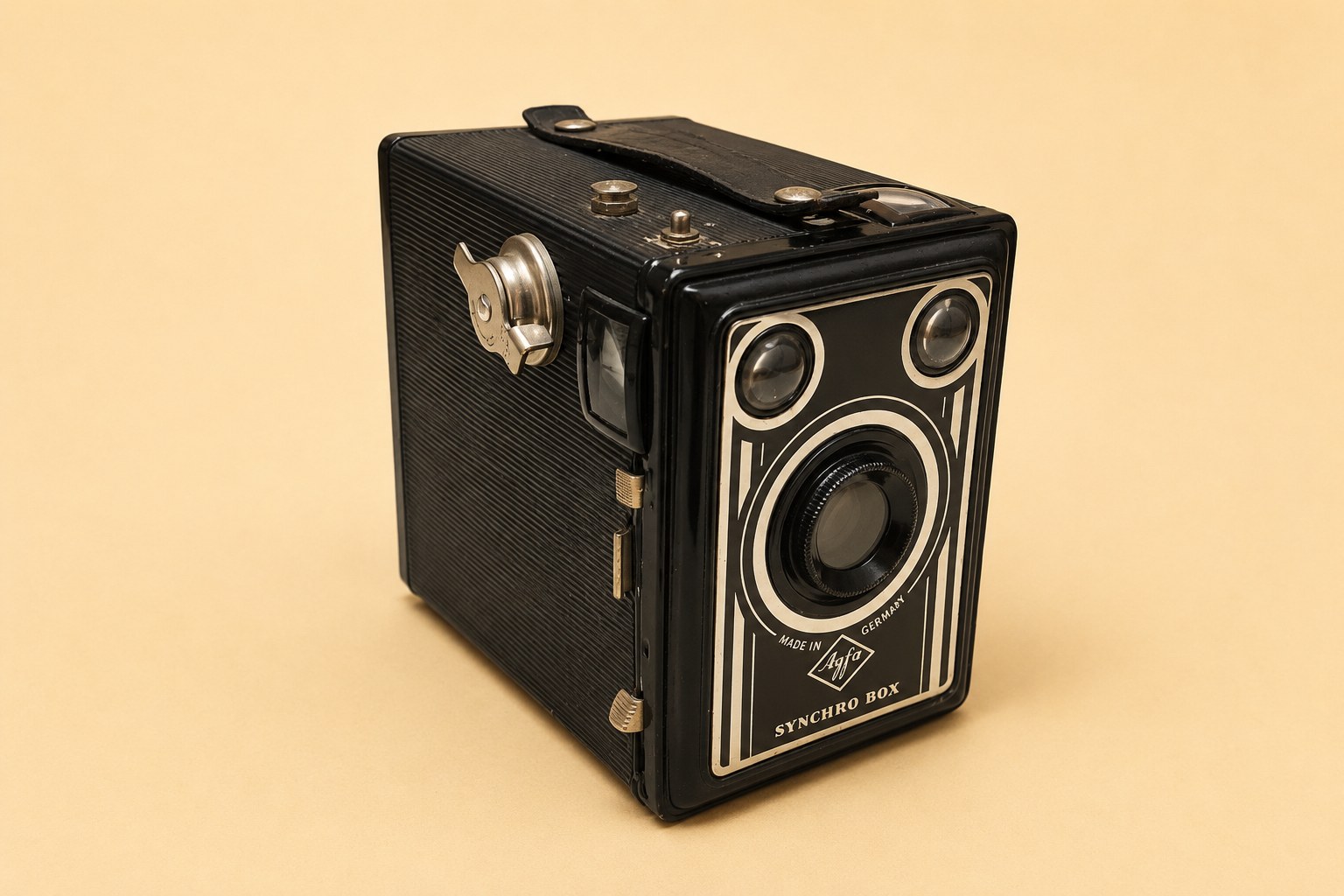
A German 1950s box camera, complete with its multilingual manual — and found still loaded with an exposed, undeveloped roll of Fuji Provia slide film, a ~20-year-old mystery awaiting the lab.