Optics & Photography
Agfa Synchro-Box
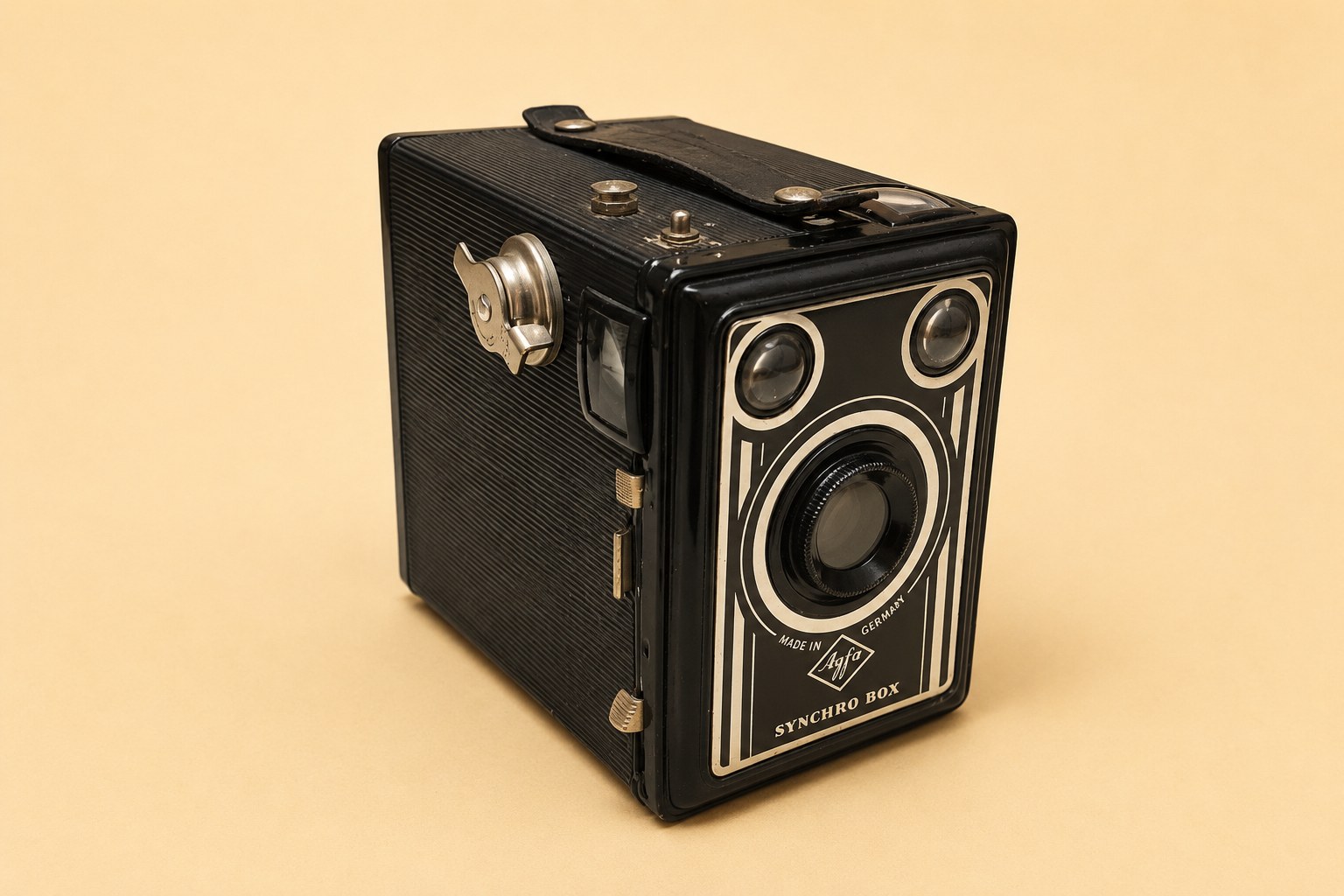
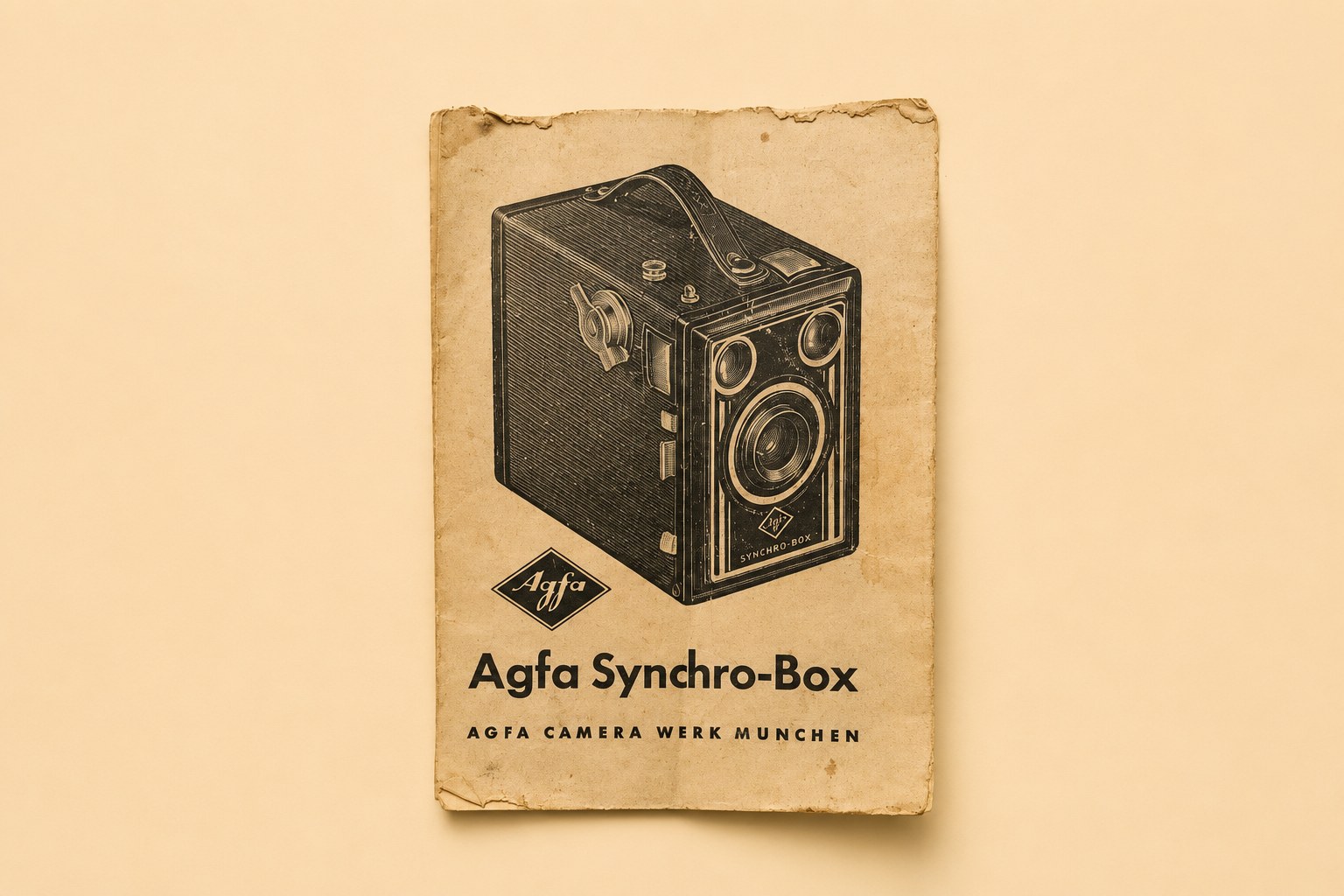
A German 1950s box camera, complete with its multilingual manual — and found still loaded with an exposed, undeveloped roll of Fuji Provia slide film, a ~20-year-old mystery awaiting the lab.
A Private Archive of Antiques & Historical Objects
Optics & Photography
A German 1950s box camera, complete with its multilingual manual — and found still loaded with an exposed, undeveloped roll of Fuji Provia slide film, a ~20-year-old mystery awaiting the lab.
A cheap black box that helped make photography possible for everyone — and, this time, a box with a secret still inside it. This Agfa Synchro-Box is a German amateur camera of the early 1950s, complete down to its folded multilingual manual. But when it arrived it was still loaded with an exposed, undeveloped roll of colour slide film. Somebody's pictures — from perhaps twenty years ago — are wound up in the dark inside, waiting.
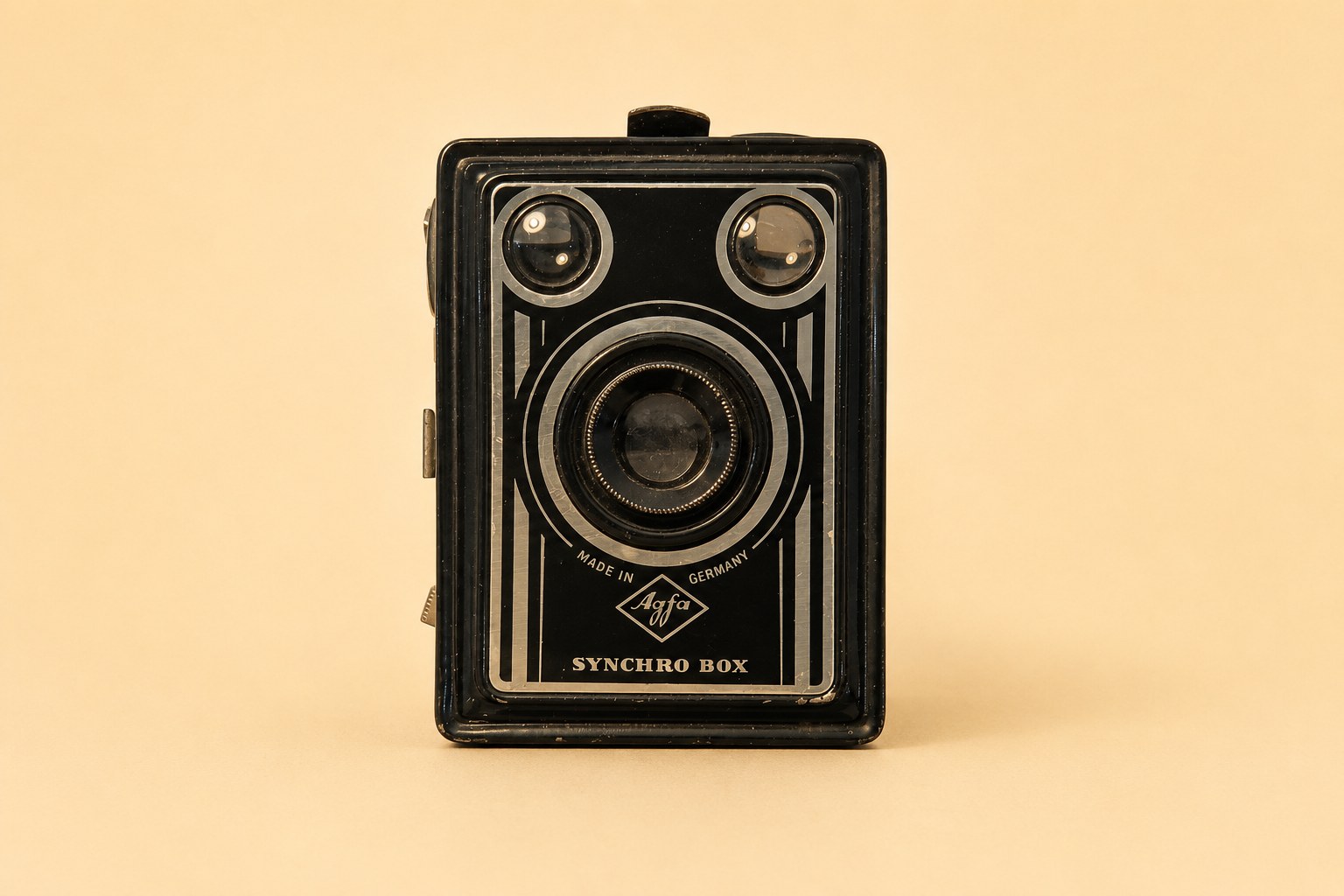
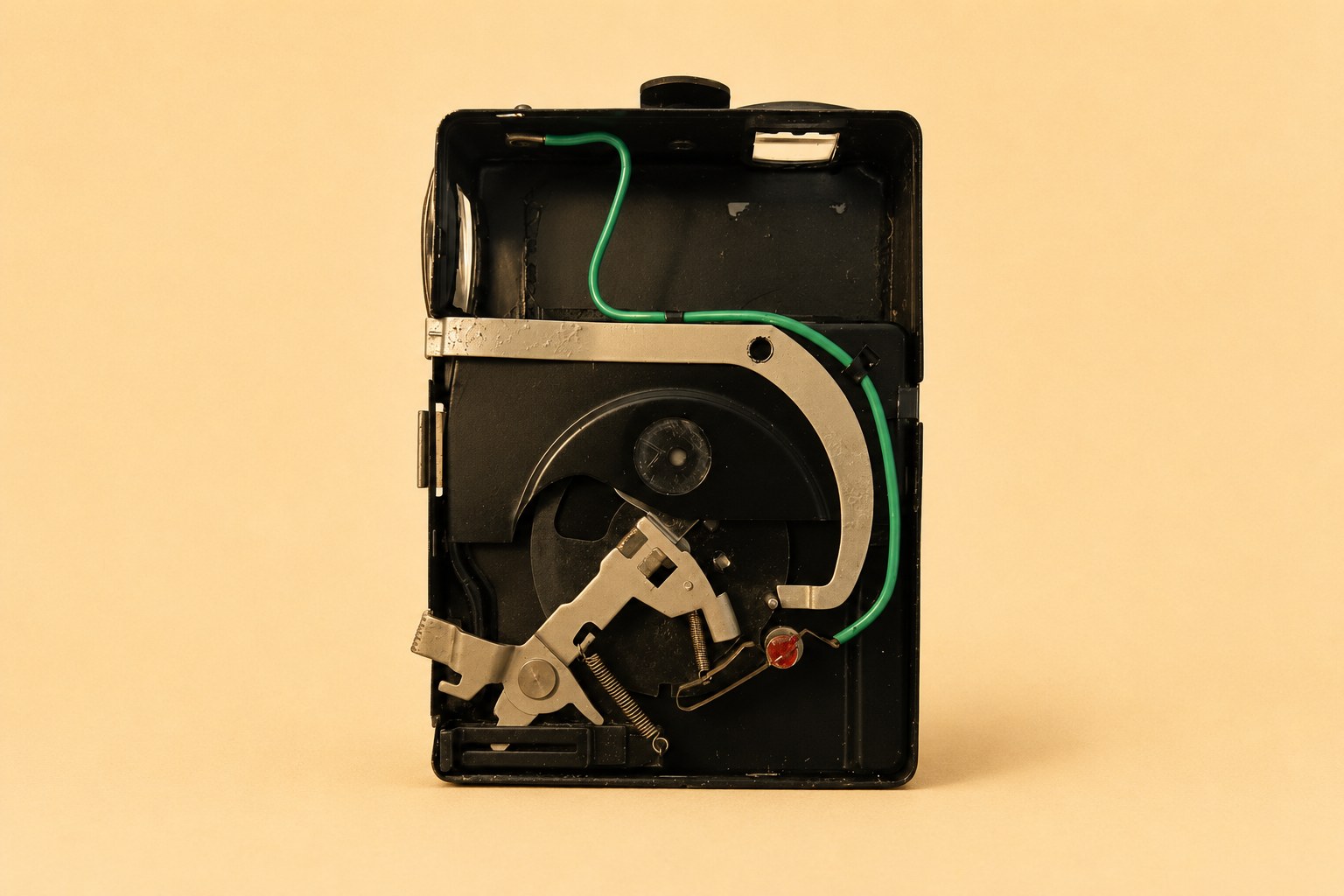
The Agfa Synchro-Box is a classic sheet-metal box camera: black enamel over embossed leatherette, a single-element 105 mm meniscus lens, and two little “brilliant” reflecting viewfinders (one for upright, one for sideways framing). Its shutter offers a single instantaneous speed of about 1/30 second plus a timed setting, with two apertures (f/11 and f/16) and a built-in yellow filter slide for skies. It makes eight 6×9 cm exposures on a roll of 120 film. The “Synchro” in the name is its one modern flourish — a flash-synchronised shutter, with contacts on the front for Agfa's Clibo flashgun — so it could be used indoors as well as out.
It was made by Agfa's Camera-Werk in Munich between 1951 and 1957. Agfa — the Aktien-Gesellschaft für Anilin-Fabrikation — was one of the giants of European photography, making film, paper, chemicals and cameras alike, and the Synchro-Box was its cheap, dependable entry model: the German cousin of the humble box Brownies and Ensigns that put a camera into ordinary households across the post-war years.
Box cameras were the machines that democratised the snapshot — no focusing, no exposure to set, just point and press. By the early 1950s they were the last and cheapest survivors of that tradition, on the eve of the 35 mm and Instamatic age. This camera is a near-twin in spirit of the collection's Ross Ensign Ful-Vue Super of 1954, and it belongs to the same story the Camera and the Album narrative tells: the moment photography stopped being a service you paid a professional to perform and became a thing anyone could do.
The real find is what was loaded in it: an exposed but undeveloped 120 roll of Fujifilm Provia 400F — a high-speed E6 colour-reversal (slide) film, plainly marked EXPOSED / 撮影済 — which Fuji discontinued in 2006. So someone loaded a modern Japanese slide film into this 1950s German box camera, shot a roll (most likely in the 2000s), and simply never had it processed. Twenty-odd years later the latent images are, in principle, still there — though whether they survived is another matter, for colour slide film is unforgiving of age and heat. A Plymouth shop removed the roll but declined to develop it; it is being kept intact until a lab that handles E6 and found film can attempt it. The camera thus carries its own unfinished exposure: a set of pictures that no one has ever seen.
Complete and in full working order. Everything functions as it should: the yellow filter slide, and both shutter modes — the instantaneous setting, which opens and closes the shutter in a single (~1/30-second) action on its own, and the time setting, on which the shutter stays open until it is released by hand. Body and both brilliant finders are intact, the leatherette covering and leather carry-strap present, and — unusually — the original folded instruction leaflet (Agfa Camera-Werk München, printed in German, English, Dutch and Swedish) is preserved with it. No serial number is present — which is normal for Agfa box cameras of this class: they were mass-produced budget models and generally left the factory unnumbered, so its absence is expected rather than a concern. There is light wear consistent with a genuinely used household camera.
On its own it is a good, complete example of the last generation of the box camera — the object that made everyone a photographer. But it is the loaded, unseen roll that makes this one particular: it is at once a camera and an undeveloped photograph, a machine still holding the images of an anonymous afternoon. Whatever the lab eventually returns — a set of pictures, a fogged blank, or a ghost of colour — the object already embodies the collection's favourite condition: a story not yet finished.
Provenance
Acquired 11 February 2026 as one of a four-item lot (£56.64 total; ~£14.16 allocated to this camera). Found still loaded with an exposed but undeveloped 120 roll of Fujifilm Provia 400F. A Plymouth photo shop (MyPhoto) removed the roll but could not process it; the film is retained intact, awaiting a lab that handles E6 / found film. Complete original manual (Agfa Camera-Werk München, multilingual) present.
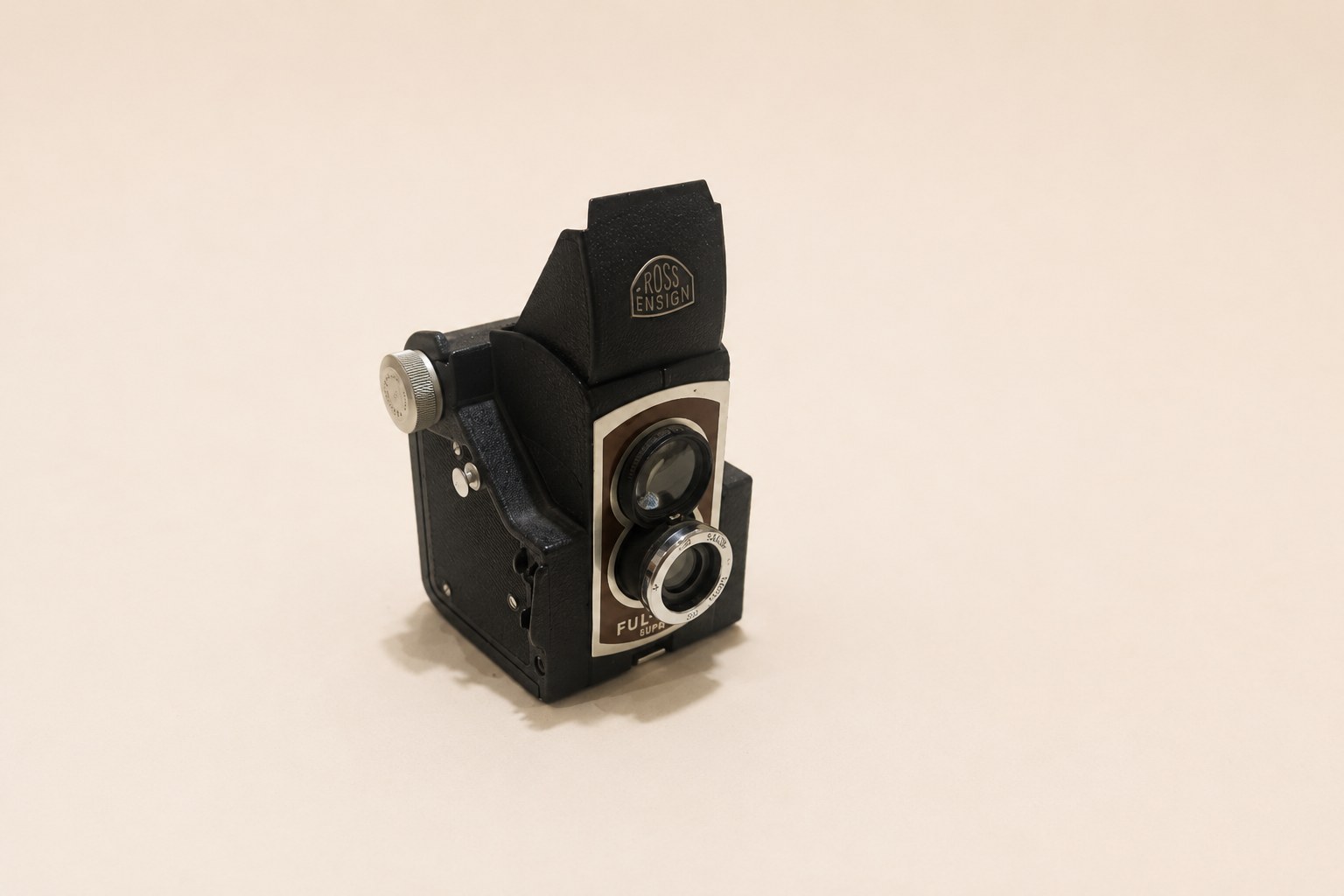
Ensign Ful-Vue Super Camera
The camera that taught Britain to look down, not through: a 1954 Ross Ensign pseudo-TLR with a glowing waist-level finder, one shutter speed, and a lineage reaching back to Daguerre's London licence of 1839.
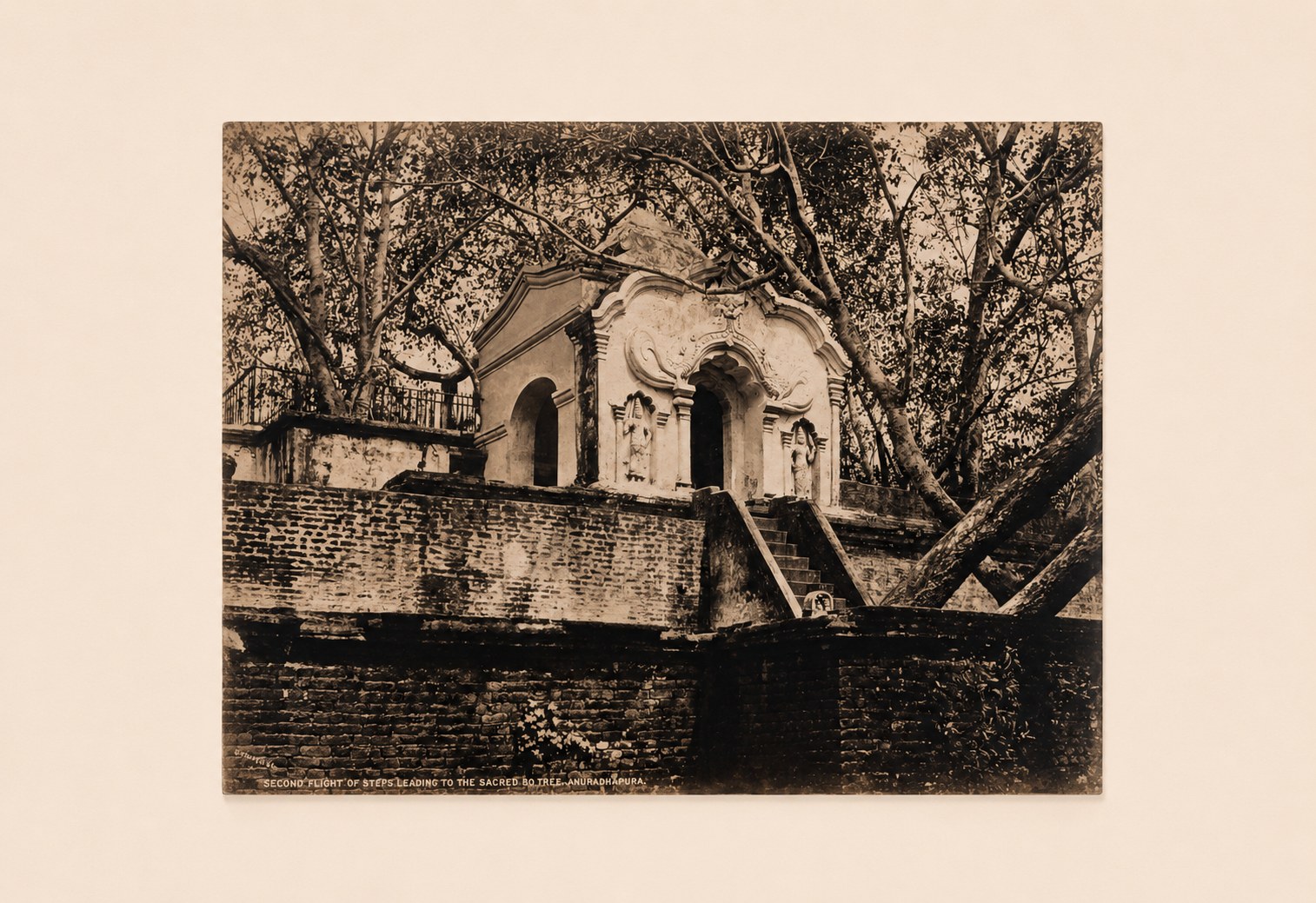
Sacred Bo Tree, Anuradhapura
A Scowen & Co. albumen view of the terraced steps to the Sacred Bo Tree at Anuradhapura — the oldest human-planted tree on earth with a recorded planting date.
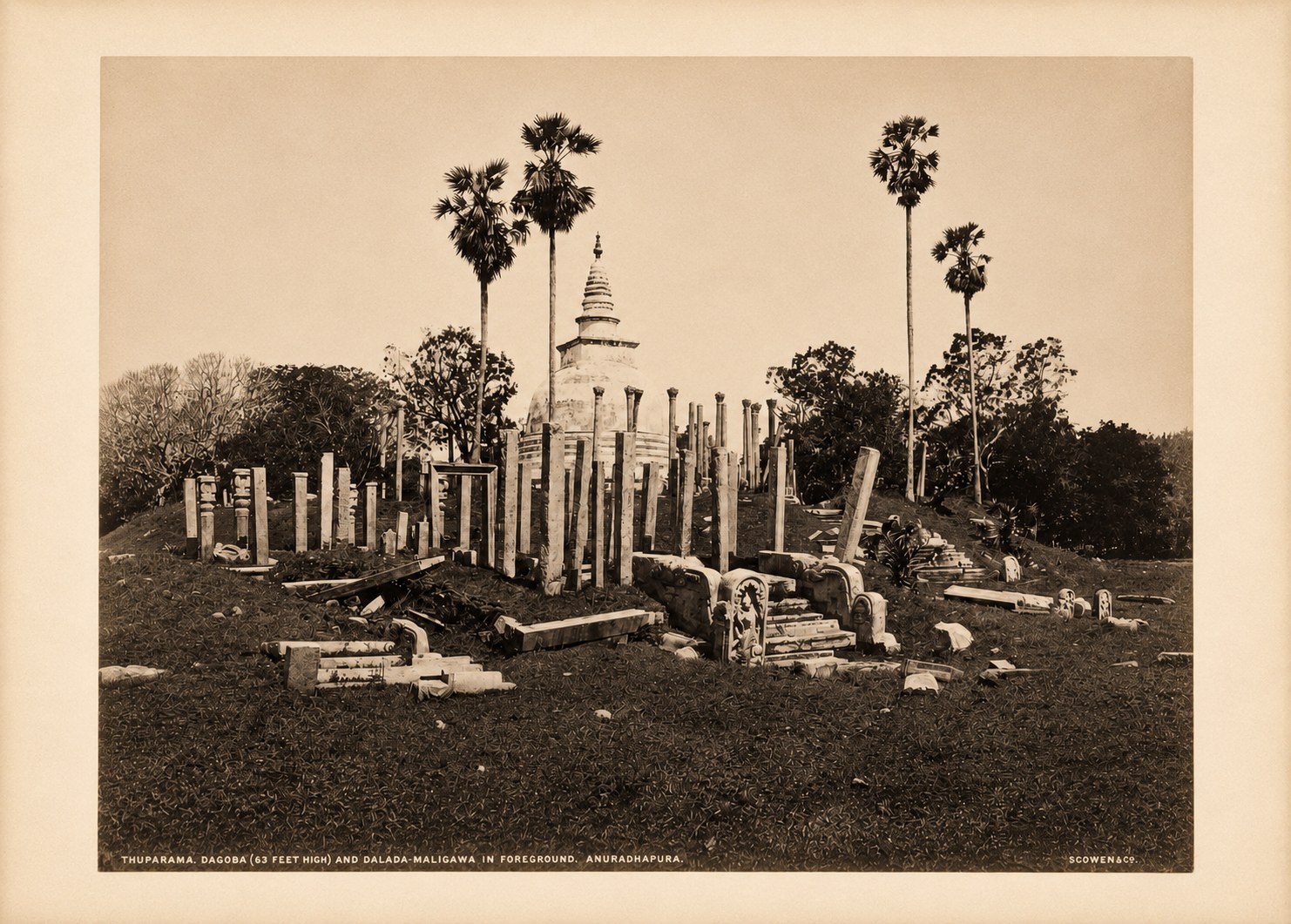
Thuparama Dagoba & Dalada Maligawa, Anuradhapura
Scowen & Co.'s albumen view of Thuparama — the first stupa built in Sri Lanka — ringed by the leaning pillars of its ancient relic-house and a lost Temple of the Tooth.