Opening
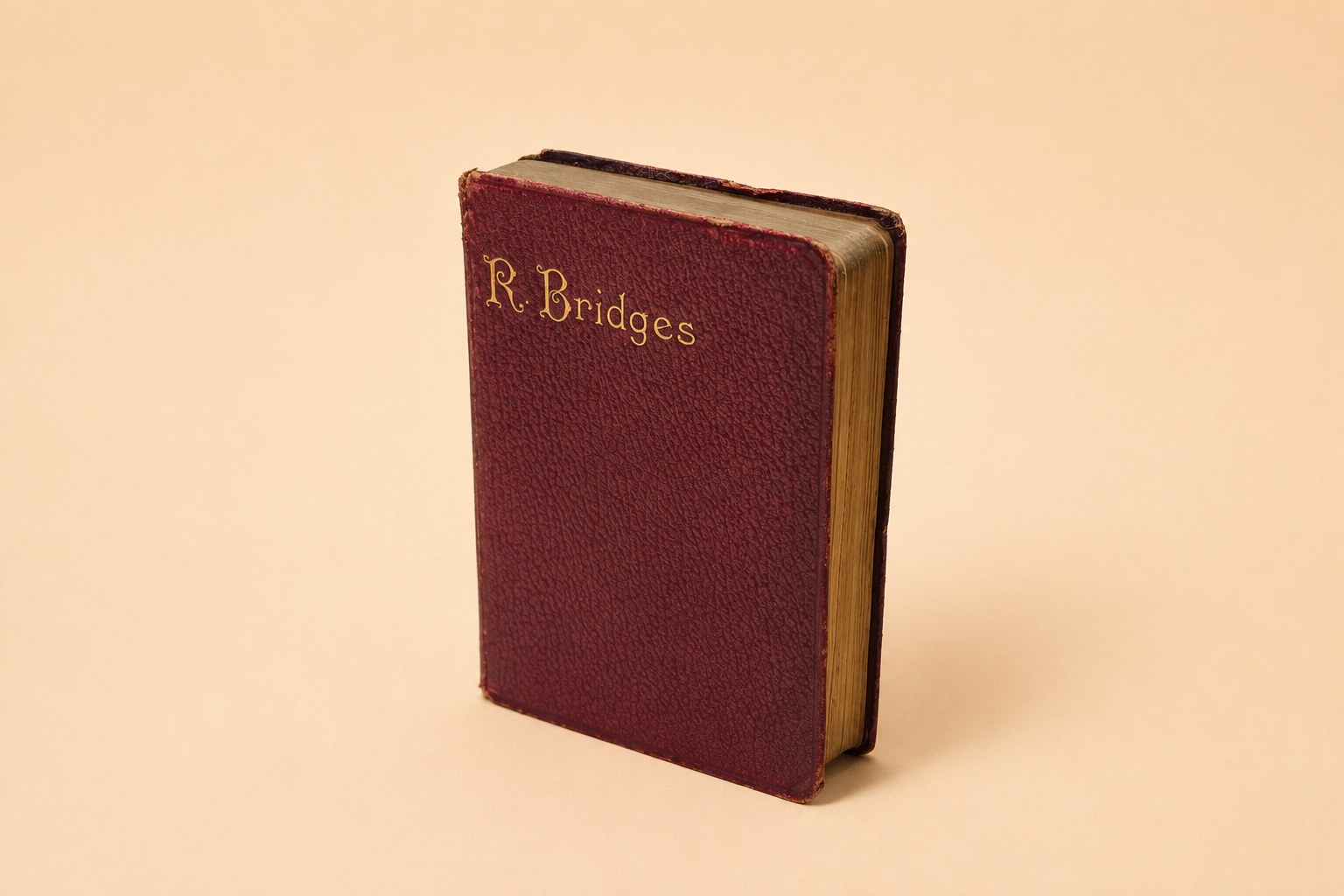
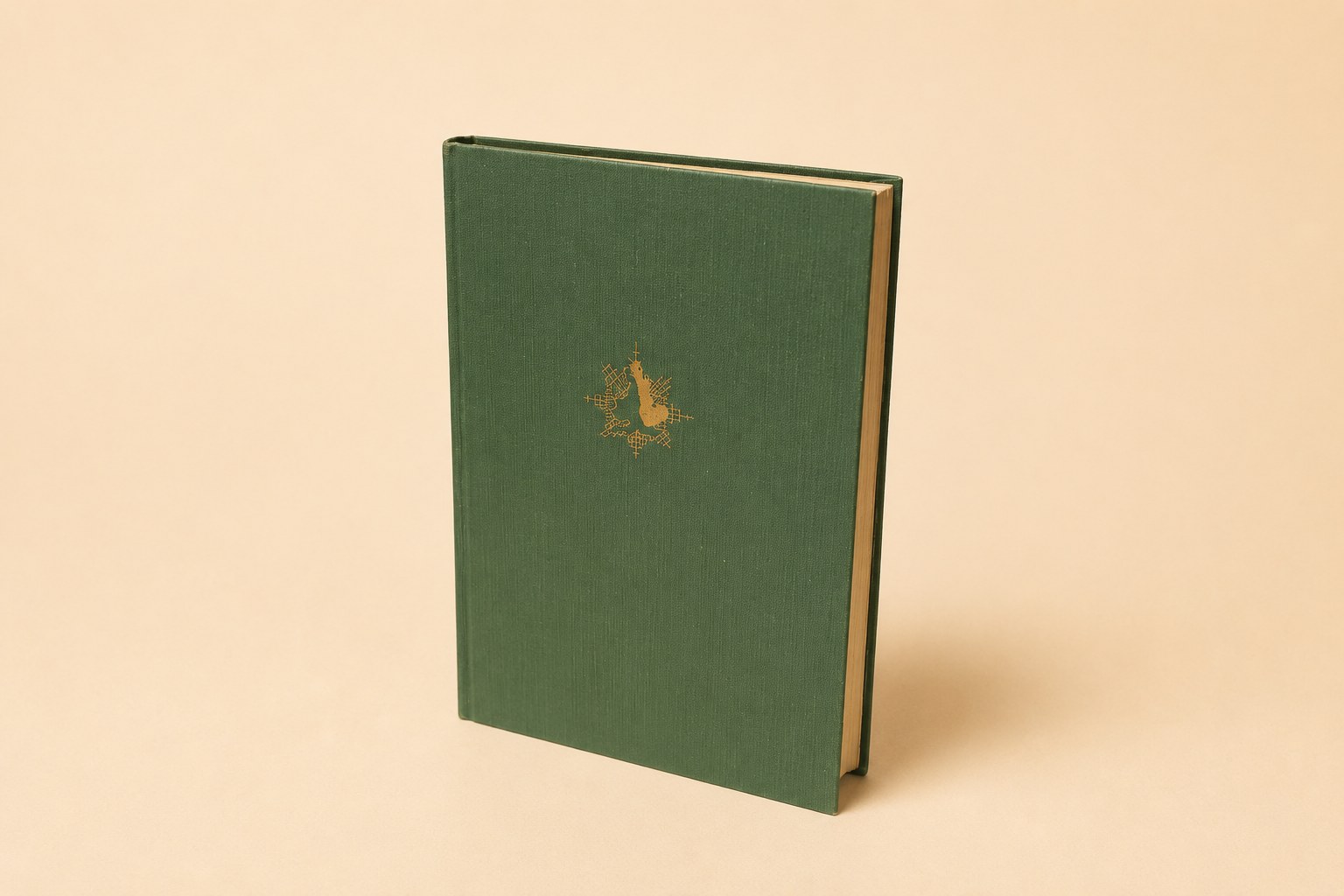
This small, gilt-edged volume is three objects in one: a book, a gift, and a scrapbook. The book is the Poet Laureate's collected verse in its 1914 Oxford Edition. The gift is a Christmas present of 1920 — To Dear Alice, with fondest love. And the scrapbook is the pair of newspaper clippings a later reader slipped between its leaves, freezing a slice of literary England as it stood in 1936. Few inexpensive books carry their own social history so legibly.
The Object
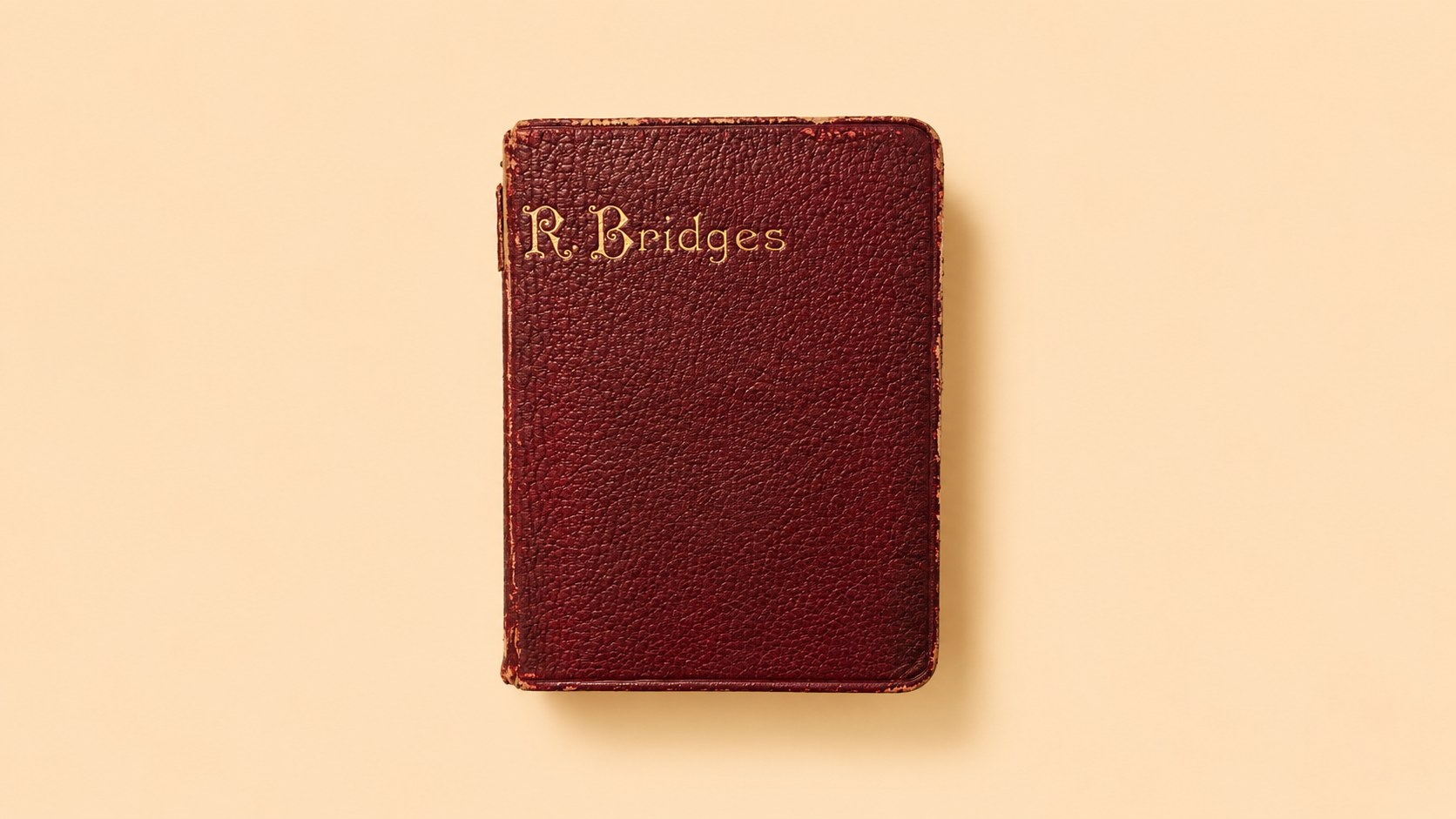
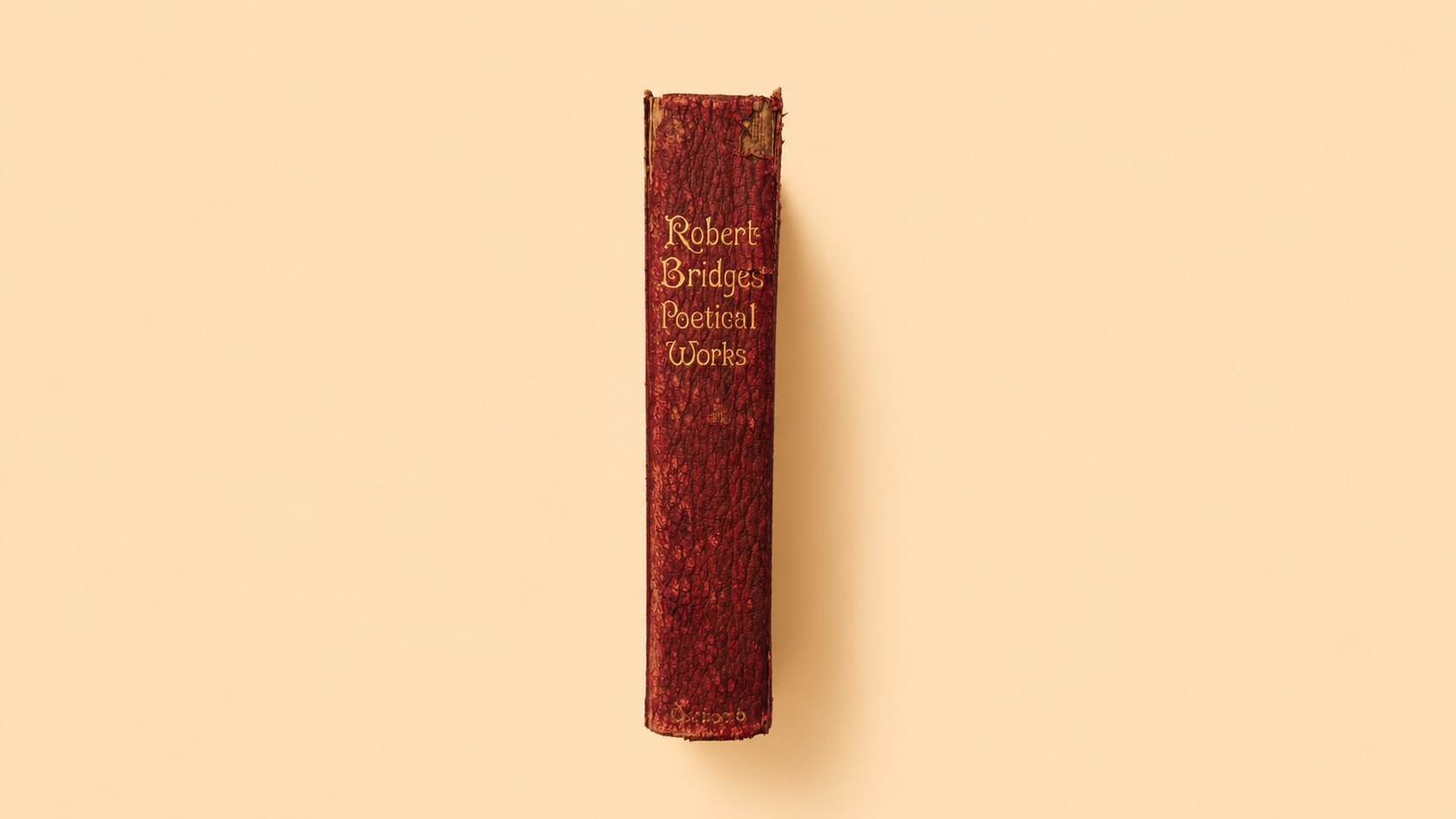
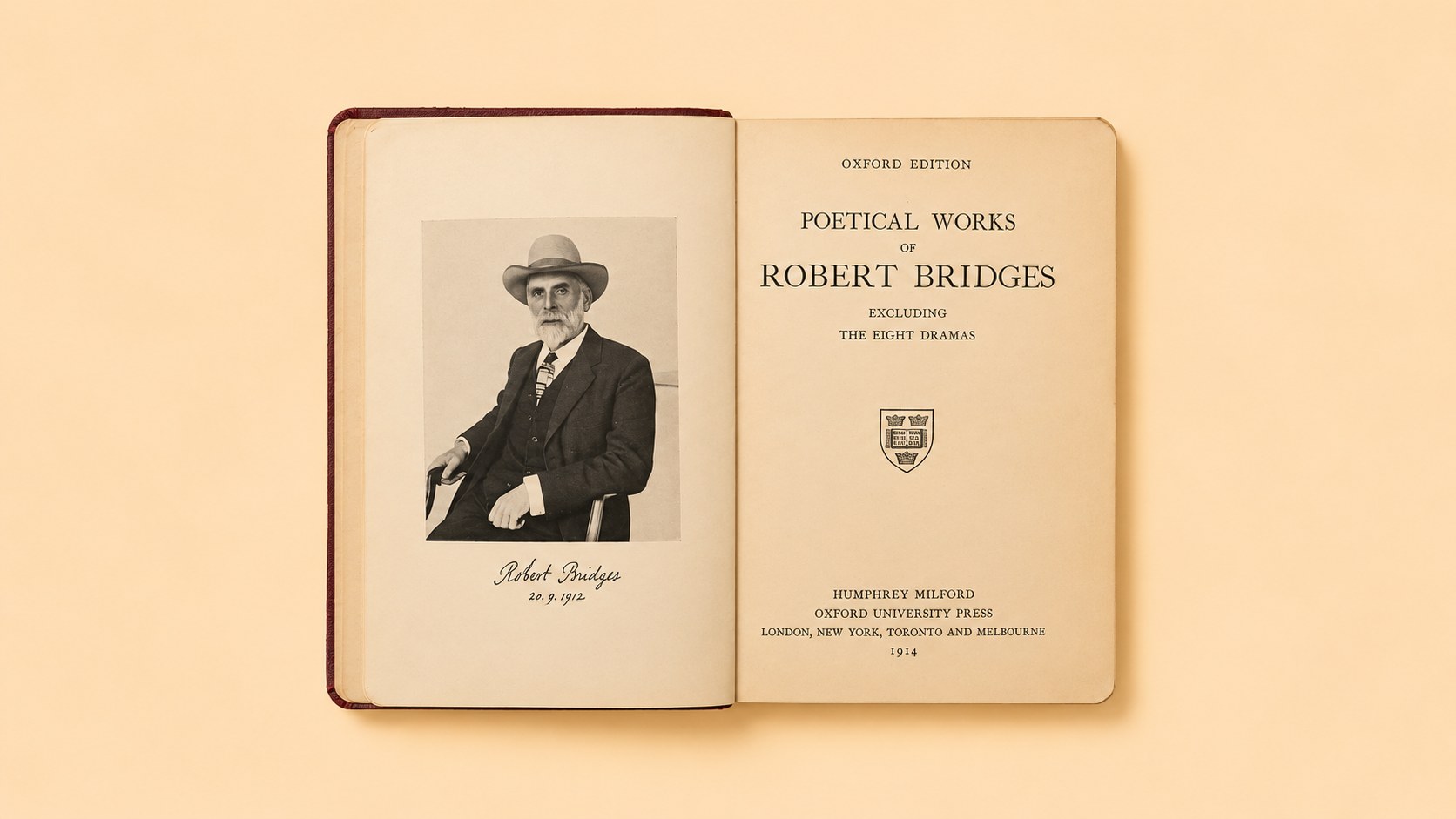
The title page reads Poetical Works of Robert Bridges, excluding the Eight Dramas — Oxford Edition, published by Humphrey Milford at the Oxford University Press (London, New York, Toronto and Melbourne) in 1914, and printed at Oxford by Horace Hart, Printer to the University. It is a pocket gift-edition: a limp maroon binding with rounded corners, gilt page-edges and marbled endpapers, the text running from Prometheus the Firegiver and Eros and Psyche through The Growth of Love, the five books of Shorter Poems, and the Poems in Classical Prosody that show off Bridges' lifelong obsession with metre.
The frontispiece is a photogravure portrait of the poet — bearded, broad-hatted — beneath a facsimile signature dated Aug 1912. That signature is a printed facsimile, not an original autograph; and, as it happens, one of the clippings laid into this very book singles it out for criticism. The same frontispiece photograph is what identifies this as the first Oxford Edition: later printings replaced it with Charles Wellington Furse's painted portrait.
The Poet
Robert Bridges (1844–1930) is the rare Poet Laureate who is now remembered less for his own verse than for a single act of literary rescue. Trained as a physician, he gave up medicine for poetry and a life of scholarly seclusion near Oxford, succeeding Alfred Austin as Poet Laureate in 1913 — so this 1914 collection appeared at the very start of his laureateship. His late philosophical poem The Testament of Beauty (1929) became an unexpected bestseller in his eighties. But his most enduring legacy came in 1918, when he edited and published the first collection of the poems of his late friend Gerard Manley Hopkins — thirty years after Hopkins's death — and so handed the twentieth century one of its great poets. He also founded the Society for Pure English. This volume, predating both those landmarks, catches the Laureate at the threshold of his public fame.
The Inscription
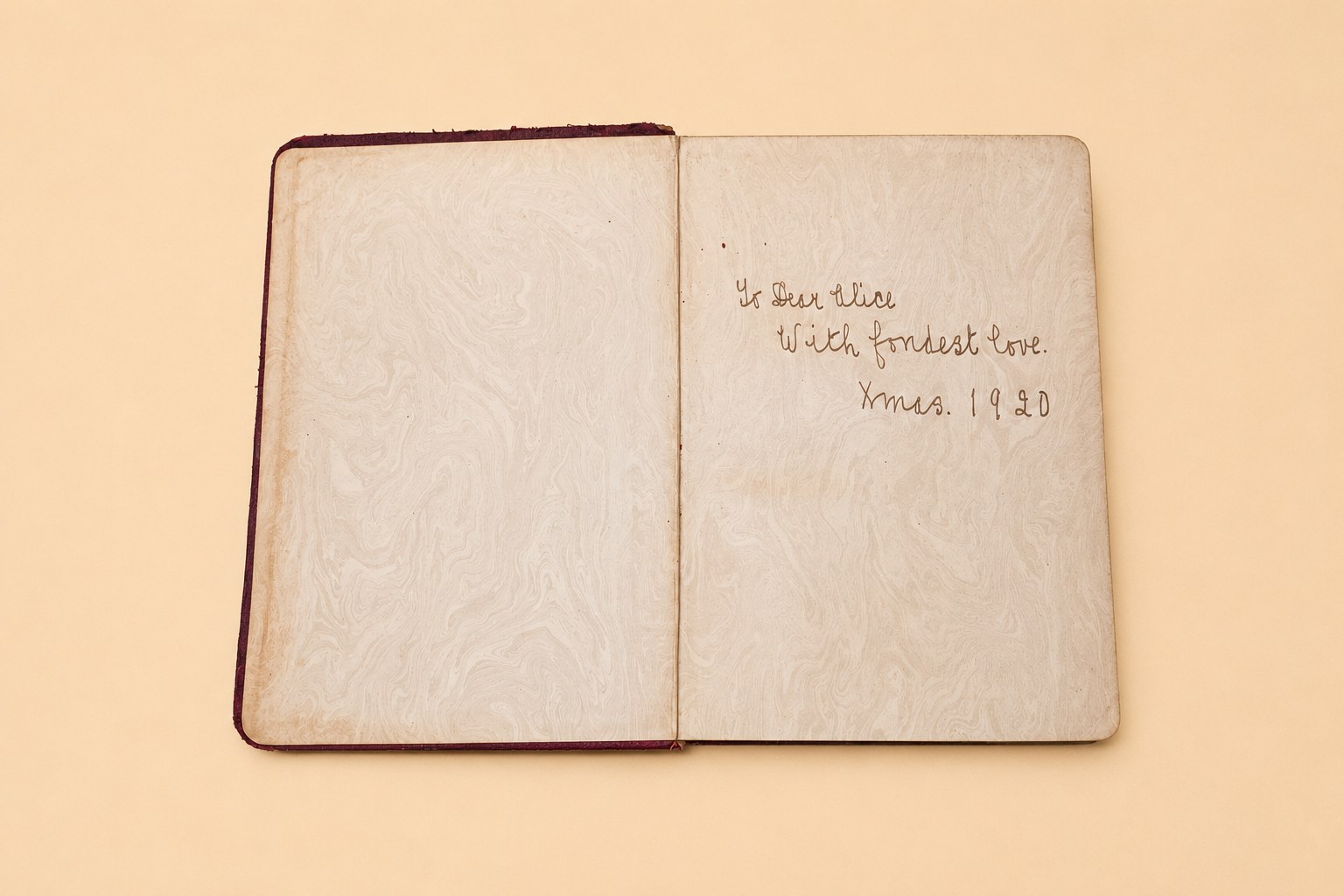
On the marbled front flyleaf, in a careful hand: “To Dear Alice / With fondest love. / Xmas. 1920.” Neither giver nor recipient is identified, and the gift is six years younger than the book — a second-hand or simply long-kept copy passed on as a Christmas present in 1920, when Bridges was the reigning Laureate and a fashionable thing to give. It is an ordinary act of affection, and exactly the sort of human trace that turns a common edition into a particular object.
The Clippings
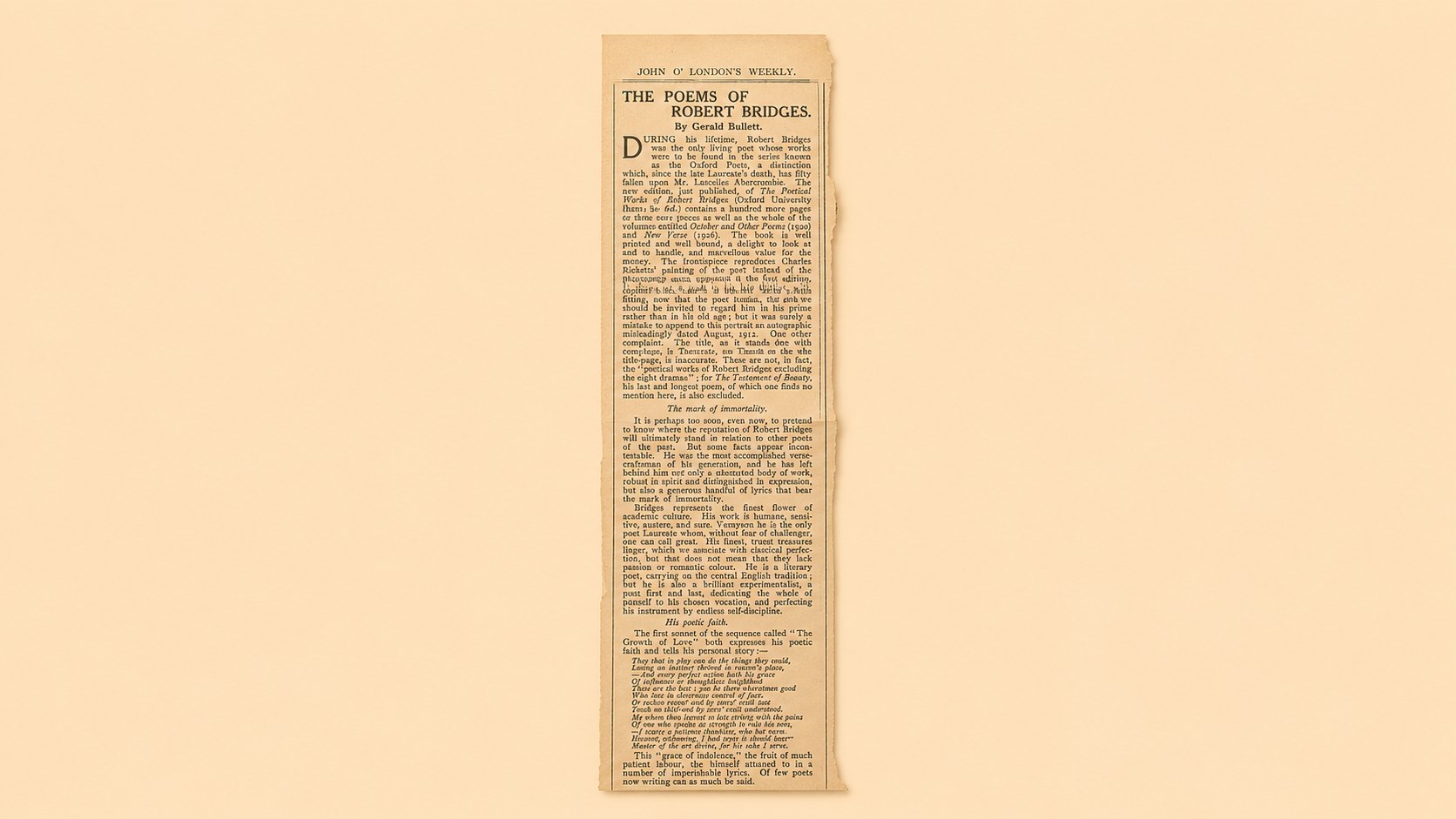
Tucked inside are two columns clipped from John o' London's Weekly, the leading British literary weekly of the period (George Newnes Ltd, 1919–1954, circulation around 80,000). The first, The Poems of Robert Bridges by the critic Gerald Bullett, reviews a new and enlarged edition of the Poetical Works — and, in a small miracle of relevance, complains that “it was surely a mistake to append to this portrait an autograph misleadingly dated August, 1912,” the very facsimile signature in the owner's own copy. Because Bullett refers to “the late Laureate,” the clipping must postdate Bridges' death in 1930.
The second clipping, headed Triumph and signed Richard Prentis, is a rave for a production of Chekhov's The Seagull, illustrated with a photograph of “Miss Peggy Ashcroft and Mr John Gielgud… at the New Theatre.” This fixes its date precisely: Theodore Komisarjevsky's Seagull opened at the New Theatre on 20 May 1936 — the first West End staging of a Chekhov play, with John Gielgud as Trigorin, Ashcroft as Nina, Edith Evans, and a young Alec Guinness in a bit part. Whoever owned this book in 1936 was reading the best literary journalism of the day and saving the pieces that mattered to them, inside their Bridges.
This Copy
The book is in good condition: binding sound, gilt edges bright, the inscription clean and legible. The chief conservation note is the laid-in newsprint, which is acidic and may, over a century, have lightly toned the facing leaves; the clippings themselves are intact and form part of the object's interest rather than a defect. Measurements to follow.
Why It Matters
The printed text is common; the copy is not. As an edition it marks the opening of Bridges' laureateship in 1914. As an inscribed gift it preserves an unrecorded private affection of Christmas 1920. And as an accidental archive it holds two clippings that, together, sketch the literary culture of 1936 — one of them looping back to comment on the book's own frontispiece, the other capturing a landmark of the English stage. It belongs to the collection as a study in how an ordinary book accretes meaning: the same impulse that fills the rest of these shelves, caught here inside a single maroon binding.
References
- Robert Bridges, Wikipedia
- Robert Bridges, Encyclopædia Britannica
- Robert Bridges, Poetry Foundation
- Gerard Manley Hopkins (poems published by Bridges, 1918), Wikipedia
- Poet Laureate of the United Kingdom, Wikipedia
- Humphrey Milford (Oxford University Press), Wikipedia
- Horace Hart (Printer to the University, Oxford), Wikipedia
- John o' London's Weekly, Wikipedia
- Gerald Bullett, Wikipedia
- Peggy Ashcroft (incl. the 1936 'Seagull'), Wikipedia
- John Gielgud, Wikipedia
- Charles Wellington Furse, Wikipedia